Tuesday, February 26, 2019

Bittersweet Romeo and Juliet


In the last two years, the company has been restaging ballets from  the treasure trove of Ballet Philippines repertoire. National Artist Alice Reyes' "Romeo and Juliet" is the last classical full length ballet to be restored before the company steps into their golden season. The idea of passage of rites at the end of the 49th season is quite fitting and beautifully symbolic. The dancers on the company frontline have been gifted with experience that can equip them as they step into the next chapter of the company's journey. Much like how Balanchine transfers his legacy through his trusted dancers, the company now has a fleet of people who worked directly with the choreographers (which is of utmost importance) in restaging moments in dance history. While it is not an assurance that the creations will be protected from ruin, there is a glimmer of hope that it will stand the test of time. There is also an opportunity to revisit the work and improve it as necessary.

Preservation Project 

This version of Romeo and Juliet was originally meant to be a commissioned work by a foreign guest choreographer. By some twist of fate it ended up being choreographed by national artist for dance Alice Reyes. The choreographer expressed that she was inspired by the grandiose Bolshoi Ballet version and the temperament of the San Francisco Michael Smuin's version. While the company has performed Romeo and Juliet several times, this version has only been performed thrice after premiering in 1981. In the recenty concluded performances the titular role was shared by Denise Parungao and guest artist extraordinaire Joseph Gatti, Monica Gana and Ronelson Yadao and Jemima Reyes and Victor Maguad. As declared by the choreographer most of it is in its original format with minor changes to adapt to skill level of the performers.

Test of Competence

The production proved to be quite a challenge for the dancers. Reyes had everyone dancing intricate patterns with grand sweeps, swivels and quickly executed partnering. This included all the character dancers who in their senior age also had to perform lifts, backbends grand battemonts (kick extensions). To say the least there were a lot of vibrant moments in the ballet celebrating the capabilities of the dancers. The competence of the company was highlighted when the Manila Symphony Orchestra would have evident misses on the tempo and the dancers would adapt to unreasonably slow timing or unbelievably quick pace. They thrived with a smile and a few unnecessary beads of sweat on their foreheads. Their coping mechanism was commendable beyond words.

Denise Parungao on opening night glistened with a new found maturity in her performance. She has always excelled in lyrical ballets but her depth in interpretation has visibly grown through the years. Her emotions were not reserved for the grand extended movements but the motionless moments as well. Her character was well sustained throughout the ballet. Fluid in movement and emotions, this may very well be one of her best performances ever.


In this version there is very little opportunity for Romeo to show off tantalizing tricks. Despite this, Joseph Gatti still captivated the audience with his  portrayal of Romeo. He still delivered his usual six pirouettes ending in arabesque and suave jumps which were highly impressive but he put a little bit more on the table to cement  his performance. His vulnerable moments were his best. Memorable was when he stabbed Tybalt. After the first unceremonious strike, he twisted the sword shoving it even deeper into the body in one vibrating movement in complete maniacal rage. Eyes fixed on Tybalt, his eyes turned soft as he had realized what he had just done. No tricks there just an authentic moment shared with the audience. It's true sometimes less is more.


Together Parungao and Gatti conquered the challenges provided by the orchestra. While they were robbed of a few moments of breath which the canned music provided they did not allow the speed of the tempo to take away the whirlwind effect of the balcony scene. Their transition from one lift to another were silky smooth. With every luxurious backbend or grand lift so much emotion was drawn out. They were equally mesmerizing in the bed scene. They were, throughout the ballet, fully committed to each other melting my heart both as a dancer and as an audience member.


Noteworthy were the performances of Ballet Philippines' technicians. Eugene Obile as Tybalt, Earl Arisola as Mercutio and Victor Maguad as Benvolio all delivered the required testosterone to dance side by side Joseph Gatti. They represented strong dancing from the Philippines with their expansive leaps and clean footwork. Butch Esperanza who played Count Capulet moved me to tears as he carried Juliet thinking she was dead. Every bit a veteran his face alone told the story of instant regret and inconsolable forlorn.


Missing the pointe 

The story of the ballet is well known to many but I believe that prior knowledge of the story should not be necessary when watching a ballet. All key elements should be clear as day. While the restaging was a vibrant one, I found that there were key scenes that were overlooked or underloved. In the first act the Prince of Verona gives fair warning to both the Capulets and the Montagues that lives shall pay for the forfeit of peace. However within days, the rivalry caused the death of both Mercutio and Tybalt. In the literature, the imagery repeats itself when the Prince of Verona imposes his final say about the rivalry which makes sense of the prologue that says "Two households both alike in dignity in fair Verona... where civil blood makes civil hands unclean". The Prince of Verona giving his final judgement of Romeo was not shown in the ballet which for me is of vital importance. This missed scene emphasizes that Romeo and Juliet is not simply a love story but a story about the uselessness of rivalry and the importance of moral restraint. The scene also explains why Romeo had to leave Juliet so urgently because if he did not leave he would be killed. In this version after the bodies are taken away, Romeo's goodbye quickly follows. It should be noted that the Bolshoi version which is one of the inspirations for the ballet also did not have this scene but instead had both parties come out with the both dead bodies and the two camps blaming each other through mime and tableau framing the bed scene that ends with a goodbye.

Another important scene that was missing was the unfortunate timeline of Brother John who was supposed to deliver the Priest's message to Romeo. Since this was not included, it seemed as if the priest was irresponsible and remiss in his promise to Juliet making him out to be the ultimate murderer.

In the last scene, when Romeo comes to see the supposedly dead body, Paris is nowhere to be seen or he was presumably already killed by Romeo. This diminishes the tragedy a bit because it does not quite show how desperate and ravaged Romeo is at this time.

All the deaths with the exception of Romeo and Juliet's demise were underwhelming. When Mercutio dies, no one except his lover came to his aid. When Tybalt dies, again no one commiserated. Rosaline took over Mother Capulet's lament. She didn't even touch the body instead she and the husband performed a very cold series of choreography. No tears for Tybalt. When the Capulets found Juliet's cold body, Mother Capulet still does not have the opportunity to hold her child. In all these dying scenes, choreography was prioritized over sentimental movement which left me unaffected and unmoved. It wasn't until Romeo and Juliet's  final death that I was emotionally shaken.


A ballet is of course based on the director's vision which I fully respect and acknowledge, I just think the story could have been more true to the text had it included more of the layers and less ensemble dancing. While I had issues with the story telling there is a whole lot to still be proud of. First of all, this was a Filipino made ballet that lasted decades. The mere fact that it was ornately made by National Artist Alice Reyes with sets and costumes by National Artist  Salvador Bernal instantly makes it a historical gem worthy of preservation. Second of all, the ballet as a whole had a wealth of movement. The aesthetic of this version was strong, bold and memorable. The sequences were intricate and musical. Lastly, it is a ballet that showcased that Ballet Philippines is resilient, strong and competent. This is a company ready for their golden season.

Thursday, February 7, 2019

Transitory/Transit Story is not a Love Story


It is always a privilege to dance a pas de deux. A dance between two people is precious because you share more than space. You share a moment in time. You breathe the same air, feel the same energy and hear the same rhythm. As you go through the motions of individual or synchronized movement, your connectedness tells a story.   Hence partnerships in dance are always exciting for me to witness because it's easy to recognize relationship through context of movement. Togetherness, is such a beautiful relatable  concept to explore right?! More so for a piece called "Transit" co-choreographed by Joelle Jacinto and Jack Kek.

I usually explain my visual experience simply through describing the work but a back story is essential (or rather value adding) to the discussion of the piece.  The collaborators' individual backgrounds demonstrate how two totally different cultural and emotional standpoints can meet in the middle and create a solid path together. Jacinto is heavily trained in  ballet and contemporary. She belonged to Philippine Ballet Theatre and Company of Dance Artists performing a wide range of repertoire . Schooled in no less than the University of the Philippines,  she belongs to our country's elite academe of dance having pursued different levels of studies in Philippine Culture. Kek in contrast is highly accomplished in the  traditional  classic Chinese and Malaysian folk dance. He graduated with a the degree of Master of Fine Arts majoring in Choreography from Taipei National University of the Arts. He danced professionally with Cloud Gate  and B. Dance Company as a contemporary artist allowing him to widen his dance genres.  Malaysia brought these two together and their friendship blossomed into a Nuryev-Fonteyn like partnership with both interchanging roles as choreographer, critique and dancer and friend.  After years of dancing and choreographing for each other, they finally embarked into a collaboration piece with both of them creating. 


The piece began with just the sound of the waves crashing, Jacinto and Kek are found in stationary stillness. Jacinto began  to allow the trickling out of energy  starting with her fingers until she progressed silkily into  a series of signature vocabulary from  the neo-ethnic style of contemporary she is trained in. She evoked a strong yet feminine vibe as she transitioned into swaying  her hips  with every breath. Kek followed suit and in contrast created shapes that are similar but stylistically opposite from Jacinto's. Showing his classically trained Chinese port de bras, he established his space. They eventually found  the same rhythm dancing in their individual spaces.. They continued their contrasting sequences gravitating towards each other but like corporeal beings walking in a busy street, they did not lock their eyes.  Jacinto was eventually left alone and danced a solo establishing her own brand of movement, a combination of lyrical and quite  linear movements. Long arabesques( extension to the back), developpes devant and alasecondes (extensions to the front and side) characterized in a very pedestrian manner. Light-footed Jacinto looked as if she was searching for something. As she walked out,   Kek then launched into his pulsating solo with sharpness in his execution of static poses. With jerks here and there he also seemed to be looking for something but with an urgency that is more potent than Jacintos. They eventually found their way into each other's arms and the most interesting section of the piece commenced. As they launched into their pas de deux, they kept their differences of their movement and intertwine d themselves with complementary shapes in their signature styles. They melted into each other and in a very amazing-race like environment (and music)  dealt with the regular commute of life. The reference of daily transit was clearly seen. They established platonic friendship. This is not a love story. The sequences showed a developed dependency in their pursuit for something. Two people's fate cemented by destiny and a single goal to figure out life despite their  differences. This first part of the performance ended with both dancers dressing up presumably to leap into the next stage of their lives. 


The duo attempted to do a multi-level experience and so Kek  used the ground floor to tell his own story of exploration. He used the swing and the bench interchangeably. In this section, it's almost as if he transforms into a kid figuring out the most difficult mathematical question. How do you solve the problem of Jack Kek? His chosen music even spells the world " Maybe it's time for the old ways to die". Maybe it's time for him to go a different path? At this point, he led the audience to the second floor. 


The third section of the piece has Jacinto and Kek dancing on top of  a carpet of bubble wrap. Both dancers  go back and forth  as if preparing for a departure. It seemed like both were finally going on life changing trip , time for their old ways to die. However, the twist is that Kek brought out a luggage. and proceeded to wrap Jacinto and shove her inside the luggage. But he couldn't so left her in the middle of the room. Helpless, he walked towards us and said "One way ticket to Taiwan" . 

Transitory/Transit's story telling is glaring. It left me broken and vulnerable for a moment because of the universality of their theme. Finding someone to depend on is a beautiful thing but finding a soul mate to depend on is an ultimate blessing. When circumstances interfere, there is a choice to be made. From the mundane movement to the life changing moments, it is a continuous cycle of deciding to be part of a relationship.It is a decision to stay in each other's lives regardless if you are moving forward together or apart.  In this exploratory work, they chose to protect their blessing. The presence of a real connection was palpable making it difficult not to be emotionally invested on the dancers' performance journey. It felt very real and the goodbye truly  broke my heart. Quite ironically Kek left the day after the performance. 


Choreographically, the piece had it's moments. Memorable to me was the apparent weaving of different genres into a wonderful story of togetherness. I liked the contrasting textures. The unexpected lifts solidified their aesthetic. The piece however, had a few obstacles. The  content is quite emotional and to break the moments by the need to transfer to a different level diminished some of the magic. In between the sections, were verbal interactions with the audience that I found unnecessary because it breaks the fourth wall and the sensory experience. The length of the piece could also be reviewed for future staging because the material is strong enough. I look at this piece as one that would easily adapt to different types of staging because at it is dancer dependent more than anything. 

This collaboration was worth seeing.  I do hope as both artists grow where they are planted that they remember why they started it. At the very root of it is a search for answers, the search for possibility.  With their piece's apparent potential,  like the dancers they portrayed have a decision to make. Can they still collaborate despite distance and difficulty? Can they still  explore paths together while apart? I hope that the answer is yes because the world needs to remember how to feel again. See you soon Jacinto-Kek.


Monday, January 21, 2019

CCP's Golden Roadmap for Dance


The Cultural Center of the Philippines opened its doors back in Sept 8, 1969 enveloped with so much political and social drama. As part of its birth pains, there was death, financial loss, political unrest and international interest making its establishment a highlight in the nation's history. Despite its unsteady beginning, it successfully set the pillars of cultural cultivation. Grim, ashen, bloodstained grounds, stood as the nation's primary vehicle for preserving national identity and providing opportunities for art to evolve. Thankfully despite everything, their fifty year of pursuit of art has been quite a burst of color. CCP at fifty is now fronting their new vision for the future, an even larger display of radiant color. Vice President and Artistic Director Chris Millado confidently said that the CCP has and will continue to evolve until "Art matters to every Filipino". After extensive planning, we are now about to witness CCP's golden roadmap to achieve this through their three fold plan. First they want to showcase the Filipinos' excellence in the arts. Second they want to further this level of artistry through access to global partnership and leadership activities. Third, they want to broaden the reach of the arts in the Philippines. All these are consistent with their national role. It touches on art's past, present and future. CCP has come up with a list of twenty one major activities specifically in celebration of the fiftieth year in addition to all their current programs. (See List Below) 


I am particularly interested on how it will impact the dance community. What's in it for dance? I've rounded up a list of activities that involve major dance players. Here's their gameplan:

Exemplifying excellence in the arts

  1. The CCP Encylopedia featuring a whole volume about dance artists and dance history is now available for purchase. While this is not an activity it is a milestone because only a handful now write and document moments about dance.
  2. CCP Videomapping and Live Performances will be held at the front ramp of the CCP. It is expected to run for four to eight weeks and is expected to showcase a little bit of everything in the visual arts.
  3. An Anniversary Gala will be held in September 2019. It is inferred that the the CCP resident companies will be participating. (Ballet Philippines, Philippine Ballet Theatre, Ramon Obusan Folkloric, Bayanihan).
  4. CCP Resident Companies will have a National Tour. (Ballet Philippines, Philippine Ballet Theatre, Ramon Obusan Folkloric, Bayanihan). Regional areas will be able to get a glimpse of CCP's treasured talent pool.

Partnering for leadership in the arts

  1. Ballet Philippines will end their season with Romeo and Juliet with guest artist Joseph Gatti as Romeo. Furthermore CCP Chairman Margie Moran has announced that Ballet Philippines is working on a collaboration with "Kirov Artists".
  2. CCP will be hosting for the first time the Philippine Performing Arts Market. This gathering presents the opportunity to network. Artists can showcase and market their artworks, or season performances. Aside from this they can be presented collaboration opportunities.

Broadening the reach of the arts

  1. Pasinaya scheduled this February has been extended to three days. It will include a workshop day, a regional showcase day and a Metro Manila showcase day. As always this includes the CCP resident companies (Ballet Philippines, Philippine Ballet Theatre, Ramon Obusan Folkloric, Bayanihan) as well as a few chosen dance schools and dance companies. Everything is free of charge.
  2. CCP Libre will be launched. This simply means CCP will offer fifty shows for free within the anniversary year. It is again inferred that this includes dance as one of its major components.
  3. Siningkwenta will also be launched. This means some show tickets will be priced at Php50 pesos. Hopefully there are dance related shows applicable to this.
Why not ask for more?


For dance alone, that's quite a line up. I'm very hopeful that these efforts will cause a ripple effect awakening about dance. There is a huge market to convert, develop and maintain. But it doesn't hurt to hope for more right? You never know, the universe might just grant it.

Contemporary dance was not included in the golden anniversary plans. There is no specific program to bring them in the regionals. Of course the CCP Choreographers triple show season will still exist in 2019 but I had hoped that contemporary dance would be legitimized more through a specific project. When asked why this was so, Mr. Millado answered they are still waiting for the CCP Choreographers project to mature a little bit more before breaking new ground. It would have been really exciting if some spice was added to the CCP Choreographers Series. It is after all one of the best developments for dance.

I was hoping that in celebration of the fiftieth Anniversary that both Philippine Ballet Theatre and Ballet Philippines would be given financial support to create an original Filipino ballet. While I know both companies are scheduled to tour and perform existing nationalistic gems from their repertoire, it would be nice to close the fifty year journey with something old and something new. 

I was thinking in celebration of the fiftieth anniversary, special international scholarships can be given away. Nowadays people join competitions to get a chance to get scholarships abroad. Not everyone can afford to participate in competitions. It would have been awesome if CCP gave out international exchange opportunities to dance practitioners via layered auditions. Most resident companies have scholars but not all have the ability to sponsor international exposure. With that in mind, artistic directors of resident companies need to continuously learn and explore too. International exchanges for the leadership is also something I find very productive and encouraging of the arts.

The celebration of International Dance Day in the Philippines has been dreary for the last couple of years. I distinctly remember that during my childhood, the CCP would hold the most extravagant IDDs at the CCP Main Theater. It went beyond just a gala of Philippine Artists. Every year a major dance company from the international scene would make its way to CCP. It was always an inspiring event that people looked forward to. As a dancer I also remember performing numerous shows for International Dance Day in the regionals. These days, it is celebrated on a much smaller scale (except when it was sponsored by Ballet Manila and NCCA in 2015 and 2016). Perhaps we can relive the glory days?

Going golden

Despite my wish list, I maintain there's a lot of good things to look forward to for dance in CCP's golden year. While I continue to hope for more, I recognize that amount of effort it has taken for CCP to create a road map that almost secures a reintroduction of our culture to the Filipino people. Bravo to the people behind  the fifty roller coaster years. Bravo also to the current people at the helm who work to the bone so that a legacy of resilience can continue. From gray to colorful, I can't wait to see it golden. I wish them luck as they tread into their road map of hope.

See you all at the theatre?!


Monday, December 10, 2018

Candice Adea's Second Wind


Candice Adea in Raymonda by Ballet Philippines 

Candice Adea is a household name in ballet. After having surpassed the achievement of many dancers before her with a lustrous career peppered with awards, recognition and international experience, she now belongs to the ballet elite in the Philippines. After a short hiatus from the international scene, she accepted a First soloist contract from West Australian Ballet back in June 2018. She is currently ranked third in the female dancers as the only First soloist in the company. She is the first Filipina to ever join this sixty six year old multi-nationality state ballet company. She jumped into the Company's season mid way through preparations for Dracula and immediately she was made to understudy the lead role for future restagings of the production. Nutcracker is her first taste of being part of the creative process of West Australian Ballet. All things seem to be looking good as she was casted in so many roles. Adea bravely took on multiple roles including the titular role of Clara and Sugar Plum Fairy , Snow Queen and Chinese Ballerina in the Land of the Sweets. This casting decision signals a positive start with the Company. Filipinos who were able to witness her performance as Sugar Plum have described her as a dancer "at her peak" showing a special kind of sparkle in her eyes dancing with her new  family. Her comeback in the international scene seems solid and her outlook about the future is refreshingly positive. She is heavily missed by her following in Manila but her success in Australia is surely inspiring a lot of ballerina dreamers witnessing her story unfold. May people recognize her giant leap and see her glorious second wind bring her forward.

Here's a closer look at her Nutcracker experience. All photos courtesy of Candice Adea.


 Her West Australian Ballet reads  Click Link West Australian Ballet Dancer Candice Adea

Candice Adea was the first Filipina to win at the Helsinki International Ballet Competition taking 1st Place, Senior Women’s Division in 2012 and won a Silver Medal at the USA International Ballet Competition in the Senior Women’s Division in 2010.

Adding more achievements to her name, she was awarded by Gawad Buhay as Outstanding Female Lead Performer twice for her work in Amada (2009) and September Gala (2010), as well as two special awards at the Boston International Ballet Competition in 2011—the Maris Liepa Award for Outstanding Artistry and Lead Role in a Russian Ballet performance.

Candice was trained in the Philippines at the CCP Dance School, the Philippine High School for the Arts, and earned her Bachelor of Arts Degree Major in Dance, from De La Salle—College of Saint Benilde.

Candice has previously been Principal Dancer and Resident Guest Artist for Ballet Philippines, Soloist for Hong Kong Ballet and joined West Australian Ballet in July 2018.

Thursday, September 6, 2018

WIFIBody.ph 2018; Creatures Vs Caricatures


Two years ago, I witnessed the 10th year anniversary of the WIFI which originally was a multi-faceted festival celebrating contemporary dance. In 2016 it was a simplified and straightforward competition that left me in awe. Despite the fact that it did not have its usual frills, it achieved its original purpose which was to broaden the concept of contemporary. The vocabulary was expansive and the articulation varied. I was ecstatic that the template of the previous seasons were blurred allowing audiences to see what contemporary really means. It was a collectively strong representation of the genre. While so many dance icons have defined contemporary dance, the common denominator is that it is an art that is not contained in a particular shape, theme or medium. At the same time, dance is still an exploration of movement. In the past, I would be disappointed that people replaced the action word with bad acting or even worse something that served only as shock factor. Last season's showing was  a fitting representation of how far the Philippines has come.

That being said, I had high hopes for this season's new breed of young choreographers.I was eager to find out if the momentum was sustained. Thankfully, I had my fill of good performances from both the competitors and the previous winners. Honestly I did not love everything I saw.  There were still a few remnants of the past. However the point of WIFI is not to please audiences like me (It is impossible to please everyone anyway.) The point of WIFI is for contemporary thought to prevail. In this sense, this season just like the previous one moved a step forward. In this year's WIFI, the range of movement or technique for that matter was generally lacking but the conceptual approach of all the choreographers were very impressive. The story telling was not generic. The nuances of the pieces created space for audiences to have fun interpreting the pieces in accordance to their own set of beliefs. In a nutshell, the pieces were alive colored with meticulously planned emotions and references that audiences can relate to. The standard has been set.


Winning the top prize of this year's competition is Raul "Buboy" Raquitico Jr. His piece "Transacting Comfort" was indeed superior to all the other intelligent pieces. He explored the concept of materialism as an addiction and distracting social phenomenon. He himself performed the "body" with dancer Jan Lloyd Celecio as the measure of comfort. Raquitico appeared in the corner with his bare body hunched over. Celecio who was in black  in static movements moved towards him revealing a tape measure. In a gentle pas de deux exchange they measured each other. Celecio initiating and Raquitico responding. Celecio dressed Raquitico with a skirt but instinctively Raquitico rejected it. Eventually he obliged and wore the skirt until they danced together with the same  breath. Raquitico acclimatized with the presence of Celecio just like a person relies on temporary comforts. He leaned on him, hovered over him, was lifted by him as if he was as necessary as air. However in the end of the piece he returned to being himself, looking at his comforts as a complex creation that was completely unnecessary. He looked at  Celecio, his self created monster with the measurements that he thought were sound. In the end, he allowed himself to walk away and Celecio wrapped in tape measure stood there stoically as if his life was thinning out. In solid dramatics, the light dimmed and the tape measure unraveled out of his body with a shrieking sound dancing with the light until complete darkness came. Worthy of recognition was how Raquitico translated such an internal complex concept of mental duality into something very easy understand. The strategic use of props was a winning idea. His calm fluid combinations were  very appropriate in depicting his  train of thought. Also noteworthy is his use of space.  His patterns allowed the audience to  really understand the concept of measuring comfort. "Transacting Comfort" was inventive, powerful and engaging.


Second place was won by Jovie Ann Domingo for her piece "Walk Without Pain". Panel judge Tatsuro Ishii said it best when he described this piece as more of a theatrical unfolding rather than a dance performance. He mentioned that the strength of this piece was that it was communicative and emotive. Domingo explored the concept of death with the image of a loved one lingering even as time passed by. In the performance it was unclear to me who was dead and who was alive as they stepped in and out of their respective realms. Dancer Beauty Balaga was in a chair and  Ralph Malaque sat in a table. Both executed corporeal movements imitating an unremarkable day made remarkable by lingering memories. They eventually gravitated  in the same space and they performed a struggle to let go.


Third place went to "Namoka" a piece created by Sasa Cabalquinto. In the program it says  it is an exploration of  the individual self. The choreographer performed it herself. She appeared  dressed in layers and would play out a different emotion as she  took off layers of her costume. While her piece very clearly states it is about a single individual, my take of the piece is a bit different. I would have to refer to the iconic answer of Ms. Universe Sushmita Sen, "Just being a woman is God's gift that all of us must appreciate. The origin of a child is a mother, and is a woman. She shows a man what sharing, caring and loving is all about. That is the essence of a woman.". In blunt imagery  the piece depicted the different roles that women in the world have had to take. In sections of her piece she is seen lost, suffering, wanting, crying. In the more powerful moments when she starts undressing, she shows the image of a nurturing mother. She ends the piece with undressed but commanding. The piece to me is about empowered women.


With the competition ending, the festival director Myra Beltran presented with pride the works of the previous season winners.She was hopeful that the  performances would show maturity and depth after all the gifts they have received as a result of their win two years ago.

Beauty Balaga's new piece "Opinion is like and Asshole Everyone Has It" was quite a departure from her previous choreography. In a monotonous manner,  the dancers came in and followed a straight line  opening their mouths as if they were receiving communion  or giving confession to a cult pastor in an unthinking manner. They congregated and sat in chairs where they moved in unison as a one body. A girl entered  and spoke in sign language and everybody started talking randomly about her.  She went  to them and was  moved by the people without touching her. When she finally ascended they followed her moving around her as she stepped in and out of a chair. Nobody really bothered to save her from falling.  At the end of the piece the girl spoke in sign language again but this time beside a girl with red balloons. The balloons burst one by one. Each time it did, a cult member fell down. At the end, the girl left with immobile  bodies on the floor. To be honest I thought that the piece would have been more powerful with more technique in the execution. The dancers made up however with a very soulful theatrical interpretation. The storyline was all to too relatable. It clearly explained the indifference of people to  the adverse of effect of not sincerely caring about issues.  It was a very cutting emphasis that people care more about the story than the person.The girl was speaking in sign language, nobody understood it but dancers articulated their judgement. She went about them and they followed her story but nobody lifted a finger in actually being there for her. They actually let her fall. They just all reveled in their opinions. What was important was that they were spectators of a story. In the end the balloons signified  that opinions have the capacity to hurt one or more individuals if they are not shaped with the right intentions. Balaga's approach to choreography has definitely evolved. Clearly, she is now more motivated into incorporating communal interaction rather than a straightforward delivery. I view it positively because her point of view is expanding. 


Christopher Chan presented "H2 +1". He showed off his signature movement combining held yogic poses and calculated breaths and explosive dramatics. He incorporated a mix of foreign chatter which I'm sure is a thread of poetic thought. While I appreciated the performance greatly for his abilities I honestly did not understand any of it. I do not discount the art but I did want something new from him.


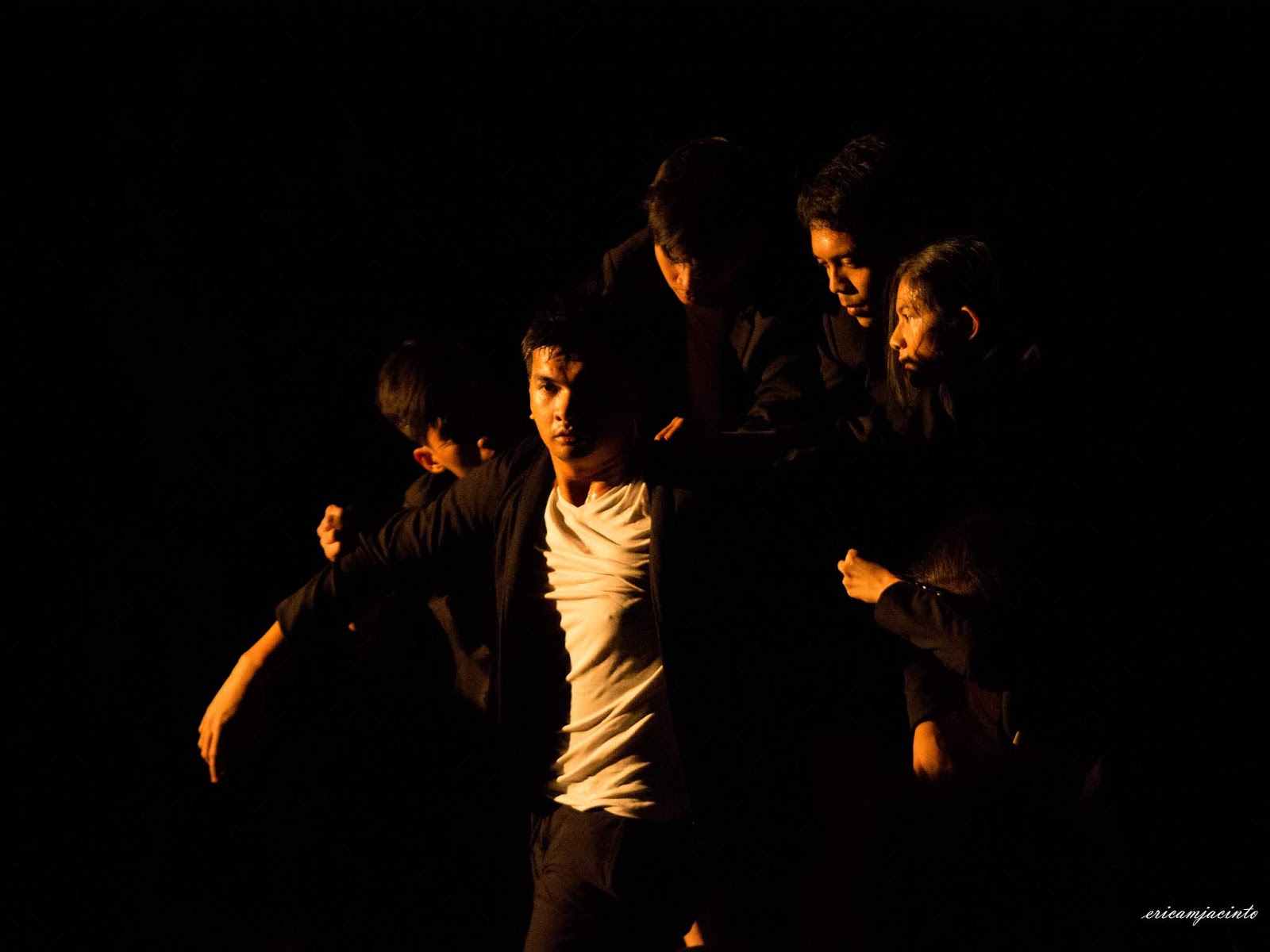
Michael Barry Que's piece is one that I would like to see in a bigger stage. I have to make mention that his casting was quite strategic with some of the best contemporary dancers casted. The mesh of dance experience and innovative spirit was a good mix, something old and something new. Que's set consisted of a clothes line with hangers with black suits. A dancers wears the suit and a few more follow. With much intensity they form an ensemble who dance fiercely  interacting in pairs, in groups and sometimes in dancing in quick solitary moments. Together they dance the life of adults. Adulting forces them to contain their individuality in favor of responsibility complying with the demands of society. The hangers remained in the set as a constant reminder  that they must be clothed with responsibility. At a certain point all of the dancers take out one by one their black coats except for soloist Al Garcia They remained colorless in white. Garcia is then thrust into a web of white with everyone threading their arms and legs  creating a webs of beautiful images. Garcia's coat is discarded but continues to dance but he does so with limited freedom. He conforms to the white movement. For me the message of the piece was brilliantly delivered  with a series of  rich memorable imagery. Clear as day was the depiction of how adulting dulls lives with the requirement to conform, deliver and succeed. Adulting doesn't end with what society expects, that is just one layer of expectations. Even in your intimate lives there will be other layers demanding  a person to conform, deliver and succeed. Perhaps it could come from family, friends, mentors. What is nice about this piece is that it doesn't force a conclusion. It doesn't necessarily portray the extremes of happiness or angst instead it delivers the state of being.  For me as an audience, it allowed me to commiserate and I guess think about my own layers. I believe Que is on the verge of unraveling his own layers.


The WIFI Body Competition was meant to be a platform to explore thought and movement in a contemporary manner. The noticeable shift of perspective from creating caricatures to representing actual creatures of God is such a big step forward. The growth of the previous winners is also a big contribution to the dance world. In closing, I encourage all creators to revel in this step forward. Opportunities like the Wifi should be more than just a stepping stone. It should be  a moment that helps you decide whether you are an artist or not. The dance world can be cruel. Obstacles and noise will always be there to pull you back. The lack of equal opportunities is also very discouraging. Not everyone will like the works as well. I can only hope that breakthroughs like this remind  the artists that to be able to create is a gift in itself. To be able to better yourself is a blessing. But the ultimate reward would be to share it with another human being filling them with a chance to think, imagine and be captivated for a moment in time. May the fight for art be won everyday.

Wednesday, September 5, 2018

Battle or Celebration of the Mixed Bill Program

Season of Flight Choreographed by Norman Walker
Photo by Jojo Mamangun 

Ballet Manila and Ballet Philippines will be sharing this weekend as they open their ballet seasons. Both will be presenting mixed bill programs that commemorate their past. It's a joint throwback.


Iconic 2.0 is the second installation of their iconic trip to memory lane. Featured are the works of local choreographers such as Gerardo Francisco (Ibong Adarna), Osias  Barosso (Ecole), Eric Cruz (Carmen), Lisa Macuja (Fur Elise) and Bam Damian III (El Adwa). Included in the program are the contributions of Martin Lawrence and Simon Hoy. Except for a few, these are major pieces that are familiar to the ballet community because they are often performed by the company. However what would be interesting to see is the debut of the new cast assuming the lead spots in these pieces. Take for example Jasmine Pia Dames performing in Bam Damian's El Adwa and Abigail Oliveiro performing Eric Cruz's Carmen. It's a reintroduction of who the new front liners are for the Company. It is a baptism of sorts that makes me giddy.

Abigail Oliveiro in Eric Cruz' Carmen
Photo by Gnie Arambulo 

Jasmine Pia Dames in El Adwa 


Ballet Philippines on the other hand continues their grand retrospective leading up to their golden anniversary. With the exception of one new piece "Sama Sama" by up and coming choreographer Ronelson Yadao, their season opener is a collection of pieces from the 1970s to early 1980s. Featured choreographers include Brando Miranda (Vivaldi Concerto), Norman Walker (Seasons of Flight) and of course National Artist for Dance Alice Reyes (Carmina Burana). These pieces are quite new to the eye for the newer generations. It is in a way a tribute to neo-classicism as they generally explore the ballet vocabulary in a stylized manner of story telling. Another good reason to watch this show is to see how the Company will utilize their fresh delivery of dancers. Joining the Company this season is Stephanie Santiago, AL Abraham and Earl John Arisola. Santiago is a homegrown talent of ACTS Manila who recently finished her schooling in Joffrey Ballet. AL Abraham is a skilled contemporary artist from UP Dance Company. Earl Arisola was a former soloist for the Company. It's interesting to see how they will contribute to Ballet Philippines' movement.

Carmina Burana
Photo by Jojo Mamangun 

With such a mix of pieces, surely there will be one that audiences will love. There will always be a reason to go to the theater and see our local ballet companies perform. Take your pick or watch both and come home with the satisfaction that you have been part of their journey. See you at the theatre.