Showing posts with label Contemporary dance. Show all posts

Thursday, August 7, 2025

Front Row Feelings (Not a Review)


Three Ballet Companies, One Week, and a Missed Opportunity

I’ve been privileged to watch three prominent dance companies perform, Philippine Ballet Theatre (PBT),  Alice Reyes Dance Philippines (ARDP), and Ballet Philippines (BP). Seeing them just days apart allowed me to gain a real sense of the current climate of the dance community. I’m floored by how beautifully these companies coexist, each with its own distinct brand. I appreciate that all the companies (including Ballet Manila, whose show in Dumaguete I missed) are unapologetically eager to flaunt their artistic identities and express—through dance—what they feel the audience needs to see.

A Quick Recap of What I Watched

Philippine Ballet Theatre, after a melodramatic and technically challenging performance of "Maria Makiling" at the Samsung Performing Arts Theater, opted to showcase "Music in Motion", a widely toured mixed-bill dance performance featuring 100% Original Pilipino Music. This was presented at the pre-opening show, marking a strong cultural debut for the new venue at the Rockwell Proscenium Theater.

Alice Reyes Dance Philippines came next, also at the Rockwell Proscenium Theater, with their performance of "Pasasalamat"—another pre-opening show. It was a thoughtful mixed bill featuring works by both local and international choreographers. Notably, the program included Erl Sorilla’s Juan Tamad, a multi-sensory neoclassical piece that wove together music, theater, and dance.

It’s worth noting that Pasasalamat followed Pagdiriwang, ARDP’s earlier program filled mostly with old favorites—“oldies but goodies,” as some might say. While Pagdiriwang was a celebration of tried-and-true repertoire, I admit I began to worry that the company might start playing it safe. But Pasasalamat put those fears to rest. It was predominantly composed of new works, reaffirming my belief that ARDP remains committed to traversing beyond its comfort zone and continually evolving its artistic voice.


Ballet Philippines, meanwhile, presented a family-friendly double bill of "Peter and the Wolf and Little Red Riding Hood", in collaboration with two cultural giants—Repertory Philippines and the Manila Symphony Orchestra. The production showcased the possibilities of movement contributing to theatrical storytelling—the magic of live symphonies dancing through the air—and, of course, their core offering: classical ballet.


On Yin and Yang, and the Power of Contrast

How beautiful is it that ARDP and Ballet Philippines both created—as stated clearly in their program notes—full-bodied pieces tailor-fit for children? Let me repeat that: both companies created works not for the elite, the high-nosed, or the so-called “cultured” art patrons, but for children.

ARDP brought to life the beloved Filipino stereotype Juan Tamad, along with other literary figures, in a way that had kids squealing in laughter and cheering for the heroine. In contrast, BP turned to Western fairy tales to educate and entertain, using the timeless magic of story to connect with its youngest viewers. These weren’t “watered-down” versions of ballet—they were custom-made works that prioritized a segment of the audience often hesitant or excluded from the traditional ballet experience. And both were so easy to love.


For a moment, in both shows, I felt like a kid again. The novelty of the characters, the richness of the music, the familiarity of the literary sources—all of it simply invoked joy. Choreographer Erl Sorilla captured the Filipino essence with humor and warmth, while Misha Martnyuk nailed the whimsy and wonder of fairy tale storytelling. Both works left their most important audiences—the children—with a clear and lasting moral, all while keeping the young at heart chuckling too.

ARDP and BP, like yin and yang, drew from both local and international literature and music—but with one shared goal: to spark delight and connection in young hearts.

Music in Motion—Literally and Emotionally

The Music in Motion repertoire features music by Jose Mari Chan, Raul Sunico, and hitmakers from beloved Filipino teleseryes. The musical choices resonate deeply with the everyday Filipino, and even if some elite audience members might deny it, I’ve witnessed impeccably dressed balletomanes humming and swaying along to the glorious tunes. Especially in the provinces, when this repertoire is performed, the crowd can’t help but cheer and move with the rhythm.


By depicting the beauty of mundane life in colorful and theatrical ways, the performance becomes ultra-relatable—though perhaps not for those who’ve never commuted, waited in line at a barangay hall, or crowned a neighborhood muse. Music in Motion turns unremarkable stories into remarkable experiences.

Recently, the company also revived Gener Caringal’s epic Bughaw, set to the music of Eraserheads, arranged in orchestral style by National Artist Ryan Cayabyab. Seeing that familiar music —presented in a stylized, glamorized ballet format—was simply breathtaking. It’s a powerful reminder that music not only sets the dancers in motion but also sets the audience’s emotions in motion.


Ballet Manila’s Musical Stylings

This show reminded me of another initiative from Ballet Manila. While BM did not continue my streak of show-watching because they were all the way in Dumaguete, I am quite familiar with Ballet and Ballads. It’s a unique program where the featured artists change each year, showcasing young and emerging talent. In a somewhat concert-like format, they draw crowds of young people eager to support their idols. Their collaborators include bands like Six Cycle Mind, Blaster, and Freestyle, as well as artists like Karylle and Toni Gonzaga, to name a few. Attend any Ballet and Ballads show, and you will witness the youthful energy in the audience, exhilarated by the experience. Imagine anticipating a performance from your musical idols, only to be mesmerized by the new experience of watching ballet.

The contrast and connectedness between PBT and Ballet Manila is, to me, incredibly refreshing. One feels like an old soul, reflecting on Filipino memory and identity to draw in new audiences. The other is bursting with the energy of now, riding today’s music scene to invite the next generation in. Their methods may differ, but their method is the same: to use music as a bridge that draws people into the theater. And it just works. 

Creative Diversity as Lifeblood

Art is an equalizer—it can and should be enjoyed by every age, gender, and social class. The ballet companies I mentioned clearly understand this. They recognize that creative diversity is the life force that will keep the dance community growing.

Creative diversity in art is not limited to the innovation of techniques, styles, or genres; it encompasses the intentional creation of works that resonate with new audiences. This means crafting narratives, visuals, or performances that speak to previously unheard voices, underrepresented communities, or emerging cultural currents. It involves dancing in ways that welcome—and reflect—the people watching.

A Closing Note

I can confidently say that in art, there is no perfect formula and never a perfect execution. However, if it helps people feel something, think of something, or love something, then the journey is well worth it. Anything that moves a person is HIGH ART—let no one tell you otherwise. The Philippine ballet companies clearly grasp this concept. While their visions differ, they share a common mission: to connect, to create, and to make ballet accessible to everyone.

With this mindset, growth is inevitable. I can't wait to let the rest of the season unfold.

 Bravo, Filipino.

Sunday, June 15, 2025

IDD Autobiography : Traces of You in Movement (As published in Runthru Magazine)


 Ayala Land's Circuit Makati is focused on shaping its future as a cultural hub. Its goal is to be recognized not just for its venues, but its commitment to educating, inspiring, and engaging audiences. They aim to be a catalyst for community growth, producing high-caliber events that are often inaccessible to the arts community, such as this edition of the International Dance Day Festival. This five-day festival, featuring a variety of dance genres, is a significant gift to the dance community, celebrating the art form in solidarity with global celebrations. But this year, I believe, they really hit the target. Opening night was a sterling example that Makati is a key player in the arts. Their creative choices clearly show that they have an exceptional grasp of what the community needs and how to propel them to greatness.

Even before the main event began, there was a palpable sense that this festival would be different. Showing unadulterated tenacity, dancers in suits disrupted the mundane conversations in the lobby with their exploratory movement on the escalators, responding to the flow of passersby. They gathered a small crowd, drawing attention to the evening's purpose: to celebrate dance. This performance heightened the anticipation within the dance community for the evening's highlight, Company Wayne McGregor's "Autobiography V105."

Wayne McGregor is a knighted artist in the UK who gained prominence in Europe through his mastery across various platforms, including theatre, film, commercials, and diverse dance genres. Fun fact: he contributed to the famous Harry Potter films. However, it is his acclaimed works as resident choreographer for the Royal Ballet and collaborations with the American Ballet Theatre and Bolshoi Ballet that firmly established him as a forward-thinking creative in dance. The New York Times has characterized him as "an adventuresome experimenter with a restless mind, intent on pushing his disparate audience, his collaborators, and himself." Unfortunately, his brilliance has not been widely showcased in Asia, except for his recent work "Deepstaria," which was presented in Hong Kong. Therefore, it is a significant milestone for his work to reach Filipino audiences, offering a rare opportunity to experience such high-caliber performances.


Autobiography V105: Life Without Sequence

Autobiography" is a profound exploration of McGregor's artistry, encompassing the key elements that have led to his success as a celebrated choreographer. It was the perfect choice to open the celebratory festival because it showed how powerful dance could be. It was substance on a platter, combining science of the past, science of the present, art, and humanity. The theme of autobiography reflects the essence of human nature, encompassing its highs and lows—capturing the emotions that flow through our lives: pain, joy, and everything in between. A common theme in dance, however, the process of performing it is what made the difference. It is performed differently each time.. This piece premiered in 2017, a time when people were focused on deciphering algorithms and big ideas. Dance sketches based on McGregor's genetic code were created, 23 sections, each one tied to a chromosome. For every performance, the algorithm would dictate which dances would be performed and in what sequence, akin to a roulette of combinations where the dancer's fate depended on chance. Only the beginning and the end remained constant.  In its 2025 version, the influence of AI also shapes what is performed on stage, making it an updated scientific yet artistic endeavor. The concept is significant and almost philosophical, reminding us that life is indeed abstract and has no sequence. The impact of the performance was even greater.

The audience was silenced as the curtains rose to a blank stage without wings. A solitary dancer moved, creating ripples with his body. Watching him almost felt like I was navigating his thoughts with him. Devoid of pretentious clichés often found in contemporary dance, he displayed pristine technique and control. As the company's eight other members introduced themselves in their sections, this would remain true. They were all fully immersed in the movement with confident strides, sustained balances, and most importantly, beautiful lines. It says a lot about the company's discipline in staging an abstract show. Confidence in technique allows the dancer to be present in the moment, fully engaged with the physical and emotional task. Company McGregor was indeed a class act.


The performance featured several vignettes, each with emotional resonance. The physicality of the pieces was hyper-articulate, necessitating a strong command of the combinations, as the transitions were wonderfully frenetic. There was no storyline, but you could see melancholic textures and a semblance of pivotal relationships in the pas de deux. While titled Autobiography, the performance felt less like McGregor’s alone and more like a collective diary of human experience. It carved out thoughts in my mind about my own existence—a disruption that, I believe, only true art can provoke.Did I doze off during some sections? Yes. But Autobiography’s beauty lies in its ability to draw you back in, again and again, with unexpected moments of brilliance.


Building Worlds from Light and Shadow 

Beyond the engaging choreography was McGregor’s hand in transforming blank spaces. He is an architect of sorts, creating environments for the dancers to exist, stories to flourish, and emotions to intensify.Working with lighting designer Lucy Carter, they built entire worlds using nothing but light..They used light to create the illusion of the ceiling caving in toward the dancers. At times, beams of light and projections created the illusion of ceilings and planes;, they split the stage into separate rooms, putting focus on different  narratives all at the same time.While I have seen this technique employed by other creatives, the light show is fully choreographed, almost embracing the dancers at all times. At times, they manufactured an effect where darkness seemed to swallow the dancer until they disappeared completely, achieving a strikingly cinematic result. Another memorable segment involved bright flashes of light that blinded the audience, evoking small epiphanies—those life-changing moments that leave you feeling nauseous or dizzy, reminiscent of cinematic car crash flashbacks. It was simple yet genius in its execution.


Art That Provokes


I reckon that this abstract piece is an acquired taste. Not everyone will love it. So I applaud Ayala Land's Circuit Makati for choosing a piece this intricate for the local audiences. It’s about time that people are served something as intricate and intellectually stimulating as this.Even in its minimalist version (earlier iterations included physical sets as part of the choreography), Autobiography V105 remains a conversation piece—one that leaves lasting ripples in the mind.

As Chris Mohani said in his opening speech, "Dance connects us all, transcending boundaries and uniting us through shared expression." The vibrant post-show discussions proved his words true. People are still talking, still debating, still feeling. And that, truly, is the mark of art well served.


APRIL 23, 2025
IDD GALA
SAMSUNG PERFORMING ARTS THEATRE


Saturday, January 11, 2020

Neo Filipino: On the Rise


Neo Filipino is the culminating level of the CCP Choreographers Series featuring the work of established choreographers. Being the last step of the program it has always been regarded as a spring board to greater things. It is expected to be the stimulus that can unleash the choreographer's inner dialogue trans mutated into movement. However, I have this personal impression that some audiences (and maybe even choreographers) think of the grant as simply a showcase that benefits only the creators. To me this casts a shadow on the platform's  relevance and  may depict the show as a "recital". Neo Filipino is not only meaningful for the choreographers who are given a chance to do what they are good at. It also represents the state of contemporary dance in the Philippines. The truth is there are only a few opportunities to showcase this genre in legitimate theaters. While the genre survives ferociously in this country, it is almost always performed in intimate settings with smaller audiences and with the frequency far from constant. That is why I find it imperative that Neo Filipino who has developed a passionate market represents the community fiercely reminding everyone that it is a generations's gift to another for the love of dance. It's a tradition that keeps the art (not just the dance makers) and the community alive.  I have been chronicling this endeavor for quite some time and it always shows astounding creations. However in the last two years, I felt that its ability to represent the community  was on a decline. Take into consideration Neo Filipino 2018 with the theme "The New Filipina Movement". It was obviously meant to represent the role of women in contemporary dance. However the overall message was muffled by the contradicting, off topic, or even demeaning images of the woman. While all the choreographers were organically talented, it was obvious they were also not on an even playing field. While the pieces were individually valuable collectively, it did not leave a dent in my thirsty mind. Were the choreographer's successful in their pieces? Did they grow as artists? Maybe so, but that was about it. For some perhaps it became (not necessarily on purpose) a self-serving exercise. 2017 was not any different. The theme was "Other Matters" showcasing brilliant choreographers with rehashed, old or new work that didn't quite go together. Again I cannot discount the rich aesthetics and the powerful dancing, I just hoped for a more purposeful outcome similar to choreographic platforms in other countries. To clarify I don't necessary mean that the pieces have to fit a mold or a theme. It could still send a message of hope if the curated pieces would leave an electric current running through the audience's veins, puncturing if need be (Think Himala the Musical!) I believe the Neo Filipino, like any art piece, is a snapshot of a generation and a moment in time and I would love for it to be colored with so much more than a bland portrait. Having said that, I am completely floored about Neo Filipino 2019. Exceeding my expectations, the performance was a monumental leap from recent years and was reminiscent of Neo Filipino glory days. Appropriately called "Arrest" it did make the audience stop and be in the moment. It did seize the opportunity to silence thoughts and prompt the audience to draw from the pieces something to think about for a long long time. With the extra challenge of collaboration, Ava Villanueva-Ong, Biag Gaongen, Georgette Sanchez- Vargas and JM Cabling successfully represented contemporary dance.Victoriously Neo-Filipino showed that Filipino art can be selflessly enriched by relevance, honesty, innovation, content, intent and empathy. More importantly, the pieces all had the power to put the audience in the shoes of other unheard, possibly forgotten humans. It was a way to reconnect to the real world.


Order and Disorder / Sibol
Choreographed by Ava Villanueva-Ong
Music by Krina Cayabyab (Collaborator) 

After a long hiatus in choreography, Ava Villanueva-Ong presented a worthy masterpiece to announce, what I would hope, is a real comeback. Sibol is a piece about the flow of life from birth, childhood, adolescence to adulting in real life in the perspective of a mother. It starts strong with grounded dancers running towards center stage assembling as a unit. Matching her temperament, Krina Cayabyab's eclectic beats complemented this rumbling dance piece. Interrupting the circular unified movement were  quick outward spikes of movement which progressed in speed and in range of movement until the formation transitioned into a long diagonal. In an instant, it reminded me of molecular movement. Search DNA replication and you'll easily understand how the dancers depicted somewhat the science of creation. The dancers would run in different directions as a group and melt unto each other  launching several canon patterns. With an unstoppable wind, they proceeded to dance in groups with athletic lifts and emergence of unpredictable canon sequences. Eventually the piece shifts to two boys who perform both a duet  with the  the quick tempo mellowing down. In a lighthearted interplay they emerge from the beautiful chaos as connected children playing, exploring with excited eyes. The crowd eventually comes back and the two are sucked into a vortex of organized disorder. In my eyes it was a picture of struggle, distractions. As the two boys join the grind, they adapt to the grit. The  piece ends with the two leading them towards the unknown. First they walk slowly with fear and trepidation in their eyes. But then they find a little light and it seemed like hope was at the end of the road. Despite the very structured performance, I felt that it had a relatable story. When a mother gives birth, it's utter madness. The window of safety is so short and you soon have to let go of the child's hands. When they enter into the real life, a mom is left anxious. Your heart starts beating faster than it should and you can do nothing but look on as your child makes his move. Though it's a long shot, when the soloist looks forward and walks, I hoped he was looking for comfort. In my head, maybe he was looking for mom. (I'm a mom and I would want my kid to look for mom when the going gets tough.)


The aesthetic level of this piece was exceptional. Ong overcame her initial hesitation and delivered a solid piece with a lot of heart and creativity. She had eight sessions with these kids and she came up with a crisp clean masterpiece. Despite the high technical content, Ong was able to command the bodies of the students from Philippine High School for the Arts. They looked every bit professional in the execution of highly technical lifts and difficult musical patterns. John Ferrer and Carlos Seneres who played the male soloists were fearless and just like the brothers that they portrayed, they were in sync in movement and in expression. It shows that contemporary dancing doesn't have to be cluttered with unnecessary additions, it can be pure dancing meshing beautifully with the perfect music.


Tatak Ta-tu
Choreographed by Biag Gaongen
Music by Jose Centenara Buencamino
Mixed Media Installation by Manny Montelibano

Tatak Ta-tu explores the skin tattoo as a cultural marker. For different ethnicity, it is an identifying mark, a sign of community. However nowadays, the sacramental value of it has been compromised with the rise of city side tattoo culture. Known to many, (Kalinga tattoos are now part of bucket-lists with only a portion of them understanding its roots. Note that Kalinga is only one of the many communities that have tattoo traditions) In the piece, the choreographer Biag Gaongen himself performs against the visuals of Manny Montelibano. Dramatically he began performing against a long white drape. A projection of ink dripping started framing his movement. Splashes of ink projecting on Gaongen's body. As he traverses on stage, he is seen as well on film but in the film he is dressed in traditional Igorot garb walking in city streets. On stage and on film he performs a similar routine symbolizing that he remains the same person, a proud "Igorot". You can hear questions being thrown at Gaongen "Igorot ka ba?", "Taga Sagada ka?". The questions are said almost flippantly and it shows how insensitive people can be. There's a million things that sets apart communities yet people only know or care about Baguio's famous Igorots. In Montelibano's film, I can almost imagine someone asking a native why he was wearing city clothes if he was an Igorot. Gaongen at one point writes on his body using his fingers and Montelibano supports this with ethnic patterns. The manner in which his fingers navigate his body go from furious speed to long winding strokes. At that point I could feel his frustration in dealing with the closed minded. I felt it was important for him to show that labels are stereotypes that  discredit  what it means to be a real "Igorot". To be an Igorot goes beyond skin deep tattoos, clothes or even movement. The dignity of an Igorot or any tribe for that matter is to adhere to the script of ancestral heritage. Everything is tattooed in a person's heart from the moment they look into their parents' eyes. The message of the piece was translated beautifully with the message clearly glorified. Gaongen's performance was strong enough to make me rethink if I was ever that kind of person. It definitely coaxed me to think about culture and how sensitive we really are towards history and community. I did however think that the pacing could have been faster. One dancer dancing for twenty minutes or so is tough if there are minimal highs and lows. Gaongen humbly said he did not consider himself an established choreographer as this is his first ever major piece of work. However, his artistic decision to draw from something personal was a good one. His ability to ensure that the film and visuals did not take away from his core message was also a sign that he has a strong artistic point of view.


Arrhythmia
Georgette Sanchez-Vargas
Music by Divan Gattamorta
Literature by Gianne Sanchez Sanson

I still remember having seen Arrhythmia in BP Entablado. Georgette Sanchez-Vargas created a piece about the reality of our beating heart. It explored its unpredictable nature. Without warning it beats for love and life, anger, weakness and even numbness. The piece is an ensemble piece showcasing athleticism in contemporary dance with hinges, extensions and jumps. I thought the formations were also cleverly made to look like a heart with all its ventricles and arteries interconnected. Just like a heart in love the piece was exciting. Vargas collaborated with her sister Gianne-Sanchez Sanson who created beautiful words to accompany the piece. Though I am not a fan of dance pieces being accompanied with words, I do recognize that the words that were written aptly describe the piece itself. I did  however have issues with the execution. I thought that it was not seamlessly incorporated into the piece because the dancers' momentum was constantly interrupted by the need to use technology like a laptop or a  cellphone. The words could have been voiced over so that there was no lag. As Sanson so eloquently wrote, the heartbeat becomes the music and the music gives light to the dance. There was no need to stop the music at any point because it felt like a heart stopped beating for a breath. The written sections could also have been edited to avoid too much explanation of the piece leaving something for the audience to imagine. Nonetheless, this piece speaks of power. It's explosively entertaining and memorable. It has a youthful feel and it's easy to love.


Ang Lihim ni Lea
Choreographed by JM Cabling
Dramateur/Collaborator: Tuxqs Tustaquio
Story by Augie Rivera
Music by Arvy Dimaculangan

JM Cabling is among my favorite choreographers because of the way he perceives choreography. In contemporary dance, there is a natural desire to dive into abstraction. Some choreographers end up never really figuring out what they want to say with their piece because there's little pressure to be precise. In contrast consistently crystal clear. All of his decisions seem to be purposeful. Clearly he draws far more than just his personal feelings. He must have had a deep reach of understanding towards the topics he chooses to shed light on. His successes (including this last piece) were products of dissecting research, environment, inspiration and creation. In short, I have a feeling he never just "wings it". I'm happy that such kind of choreographers are out there because it means the audience has access to more than beautiful movement and the dancers have access to relevant work.

"Ang Lihim ni Lea" is a children's story created by Augie Rivera. JM Cabling had the challenge of confronting the very layered and dark topic of sexual molestation while keeping the perspective of a child. With a reputable dramateur and director by his side, Cabling created a playground for the protagonist character Lea played by Abbey Carlos. In the story, Lea moves into a new condo and discovers that she suddenly has super powers. She had the ability to fly and go through different walls. She could see what her neighbors were doing and hear everything that was going on. Soon enough her teacher found out that her superpower was not flying. Her super power was surviving through the repetitive trauma of molestation from her father (played by Michael Barry Que). Her mind would transport her to anywhere but there in the same room where her torture took place. With a movable lightweight cube, Cabling allowed magic to happen with Carlos seen flying through walls. It allowed for transition of scenes and split scene story telling. The construction is something I have seen many times over but it worked in giving the element of magic that a children's story requires. The piece had an Alice and Wonderland feel to it (meant as a compliment) largely because of the airy transitions and the glorious visuals that really stay imprinted in your head. There was a scene where the cube kept moving and moving and it made me feel like it was sucking me into Lea's danger zone. It felt almost claustrophobic seeing Que and Carlos performing a pas de deux in between two sides of the cube intensifying the stress levels of a depiction of pain. While the story obviously ends well, it does leave you a bitter taste of the evil that exists. It is hauntingly beautiful but absolutely devastating. Worthy of mention is Carlos who portrayed Lea with a firm resolve to embody child like innocence. The support characters all contributed their own piece of magic. If there's anything to be improved I would say there were scenes that were too dark to appreciate the support characters. Without compromising the essence of the book, some edits of supporting character scenes could also benefit audience attention retention. The pliability of the structure could also be improved to minimize the necessity of the characters carrying it often as it sometimes takes away from the scenes. In other countries the structure is attached to a harness that helps move the structure around. I have also seen amazing work via motorized control. In this aspect, I would think restrictions on resources was the impediment. Having said that I look forward to seeing this piece again in the near future.


Cock Vs Cock
Choreographed by Denisa Reyes 
Reworked by Myra Beltran


Cock Vs Cock by Denisa Reyes was a riot. Over describing this piece will diminish its value. Simply put it is a poke at chauvinistic society that exists today. The stupidity of "I'm better than thou" was glorified and it was hilarious. Is it relevant? Check! Is it creatively done?! Check! Will I remember the political message every time I see a Cock? Check! It was the masters schooling  the choreographers. Art can be simple yet effective. Kudos to  Denisa Reyes and Myra Beltran who magnificently demonstrated that you need only to be 100 percent present in this world to find inspiration. An honest observation of the world can lead you to create something that will connect with an audience. Denisa Reyes always says, dance is a fleeting thing. It's an experience, a moment in time. But when the work is genius, you keep the moment. You bring it out of your pocket when you need it. It is a conversation starter-laughter inducing-politically charged piece that can be remembered and enjoyed as needed.


Collectively the pieces that were performed for Neo Filipino show that there is a profound pursuit of truths. This batch of choreographers ensured that they gave a piece of themselves to their creations investing not only their mind but their hearts. Neo Filipino has been revitalized and is raging towards authenticity, profound partnerships, innovation and contribution to society. It now ably represents that contemporary dance can be a tool for action, reaction and understanding. There is a glaze of sophistication in the pieces that makes me proud of the Filipino. I look forward to next year's Neo Filipino because surely this year's performance has set the bar high for the next set of choreographers.

Wednesday, October 16, 2019

KORYO + LAB


"To miss out on developing choreographers is to miss out on dance history. Often enough the maker is given secondary position and projection and the stellar dancer hogs the limelight. Should this remain so for long, the choreographic art itself gets encased and atrophied. It might be skillful and elegant but without the dashing waves of the new, it becomes smooth and sleek deadwood on the shore of dance history."

This insightful quote came from dance historian Steve Villaruz. If the choreographer's creative fleshing out of ideas and emotions is an after thought, then the audience misses out on conversations about life. Similarly, if nobody shows up at the theatre, then the conversation is somewhat silenced. While choreographers seem to be powerful visionaries, an empty seat in that theatre can easily paralyze. at a molecular level, their drive to create new pieces. They are human after all. Finding opportunities to stage performances is already a challenge. Crafting something out of nothing is already emotionally draining. After that effort, it cannot be discounted that an empty seat can dim someone's spirit. It is not a certainty but it is a possibility. The less people watching means less people engaging, less people challenging the message, the aesthetic and the construct of the choreographers. What do you think happens when ideas are relayed like a whisper? Not everyone is strong enough to keep a dream afloat when there seems to be nobody listening (or watching). Hence I think platforms like the WIFI Body, Koryolab and Neo Filipino who provide opportunities of growth for choreographers should be fully supported no matter what. The tripartite progression not only highlights the choreographers' skill, they acknowledge their voices and push for broadening of audiences through various ways. These projects ensures that the skill of creating is harnessed and cared for. So I encourage those who see imperfections on its execution to see that gleaming redeeming factor. Perhaps, a non deserving choreographer chosen can come out better out of the exercise. Perhaps, someone who has entertained the concept of quitting, will be encouraged to create some more. Perhaps an underdog, can surprise people with something mind blowing. Anyway, a couple of hours in the theatre is never unrewarding. Dance while it is governed by social norms like politics, rules, massive followings will come out as a product of the human mind that surely will appeal to someone out there. Time spent will surely be worthwhile.

That being said, I made it to the theatre last August 24, 2019 in support of Koryo Lab where major players in contemporary dance were ably represented. Dingdong Selga, Michael Barry Que and Sarah Samaniego are alumni of UP Dance Company. Buboy Raquitico Jr. is currently dancing for Daloy Dance Company. Christopher Chan is from Airdance.

Buhay Pagasa (House of Hope)
Choreography by Dingdong Selga
Music: Matmos, Olafur Arnalds


Dingdong Selga's brand of  emphatic choreography reminds me of "Humans of New York", a page that shares remarkable stories of people you've never met. The stories they share are shocking, tear jerking, offensive but at the end of the day their stories represent stark realities that nobody considers in their daily lives. In this edition of Koryolab, Selga's "Bahay Pag-Asa" shows the backstory of children who serve time in correctional facilities. There was nothing remarkable about his day-in-a-life story-line. It was moments of the day, thoughts of the day, laughs of the day but it was piercingly profound. Selga in his fifteen or so minute piece was able to discuss the irony that "Bahay Pag-asa" which translates to House of Hope robs children of a future. The piece began with three dancers cramped in to a cell. Struck with boredom the three engaged in sharing of corny jokes emphasizing the repetitiveness of their lives. Same, jokes, same people, same cell. The audience responded to their jokes and the shared laughter momentarily relieved their haplessness. It doesn't last long, because they are interrupted by imaginary caretakers who elicited fear and panic in them. It is at this point that Selga begins to unfold the harsh conditions that the children have to live with. They struggled to make it to the food line. They did hard labor, cleaning and scrubbing. They were silenced with brutality. All of which were done in stylized pedestrian movement with a predominant rhythm to it. The "children" in the harshest conditions thrived by sticking to each other like family. The were all going to be ok because they had each other. One of the dancers was told he had a visit from his mom. In a child like manner he looked into the darkness and waited patiently with eyes watching out for miracle. All of a sudden the solid upbeat vibe transcended into fluid melancholy. Kirby proceeded to perform a solo eliciting tears as he explored the human connection of motherly embrace and child's longing. While this is happening, a pas de deux ensued at the background framed by the steel bars. The remaining two children looked enviously at what they didn't have, love. They only really had friendship, nothing else. When the solo is over, his solace was disrupted by his friends who reminded him that all good things (at least for them) come to an end. The three go back to their prickling life where all their rights are taken away from them. The child's right to education, the right to be safe, the right to play, the right to be heard, the right to have healthcare, the right to food and water all taken away, supposedly to give them hope for a better future that seemingly will never exist. The message of this piece is achingly beautiful. It's a sad  reminder of how adults have lost touch with the important things in favor of structure. The status quo provides no hope, but we can always change the status quo right?

What was beautiful about Selga's work was how he sensitively captured the plight of the condemned children. It seems he really took the time to step into their shoes and understand how it is to live a life without hope. As choreographer and director of his piece it was evident that he communicated this well to his dancers,  Alexa Torte, Daniel Nagal and Kirby Terraza. All three dancers became colorful but broken souls. Their soulful interpretations had layers veering away from a mere comical performance. As a choreographer, Selga's brilliance is in the way he transforms the mundane actions into aesthetically beautiful movement. His work was far from pretentious or overbearing. It was not about him but about the children. HIs focus and pure mindset allowed the storytelling to become magical. Selga seems to have a preference for usage of props. In this piece he used the bench to transition and or introduce his mini vignettes. It was a person, it was a toilet, it was a bench and many more. The dancers handled the prop seamlessly and this says a lot about the preparations going into the show. Easily a crowd favorite, "Bahay Pag Asa" was a success in construction and in concept, social relevance and performance. Tears fell not just because of how emotional the piece but because a choreographer cared enough to tell this story.


Dos Mil Diecienueve Porsyento
Choreographed by Michael Barry Que
Video Projection: Aisha Polestico

This piece presented by Que is not a new piece. It already premiered in the WIFI Body as his graduation piece.  I thought it was quite gracious of Que to explain that he stood by the decision of his mentors when they said "Instagram" (which was the piece that he worked on for KORYOLAB) was not appropriate as of the moment. However, as an audience member who is interested in new works, I was extremely disappointed. Root word being KORYO standing in for choreography and LAB which means laboratory, I thought it was perfectly ok to fail at the experiment if that is what it meant to push the choreographer forward. Good and bad feedback is always valuable to the creators. I believe I echo some of his avid fans. That being said, I applaud Que for his utmost respect for his directors Myra Beltran and Denisa Reyes. While his new piece was not showcased, the presentation of his "Dos" was still beneficial to him as it reaffirmed his status as a choreographer. As he himself said, even if "INSTAGRAM" failed to make in onstage, the mentorship taught him all about the reality of deliverables.

The piece is about  the blurring of identities as our fast paced world demands adults to be a clone of ideal individuals. I have already previously lauded this piece for its strong aesthetics. For this showing, Que chose to add some elements to the choreography. The art of light, leveled up the kick of flavor to the dancing. Shadows were more prominent, and more dancer focused especially in the diagonals. The execution of the hangers coming down from above was cleaner and less screechier then before. Visually, the original parts were dramatized better. To be honest I did not see the necessity for the additional parts and music. I thought the concise version was more effective. Disappointment aside, I believe Que will emerge as a visionary choreographer one day because he pushes his creativity to the limit differentiating his style from others. Perhaps not all his works will be a hit but surely, they will be all be innovative.


Alala
Choreography by Sarah Maria Samaniego 
Music by Meredith Monk and Matmos 

In contrast to the very colorful pieces presented in Koryolab, Sarah Samaniego chose to present a very internal perspective. Her style was not ostentatious, instead it was more like a slow burn demanding you to be patient as she herself told her story. Alala means memory and as far as the dancing is concerned this was quite clear. Samaniego playing the central role, looked back at  her childhood days tracing the body that used to be with her fingers and with her body (another dancer, Katherine Sabate). She examined her old life remembering the highs and lows until she meets a turning point, the present. I appreciated the movement especially because Samaniego is a superb dancer. However, when I read the programme, I thought the explanation did not quite translate on stage. Aside from the huge set, the concept of the paper dolls was overshadowed and became a mere prop to signify childhood. I didn't see how it was meant to shape, duplicate and destroyed. The piece simply but elegantly became a reminder that  sometimes you lose a little of yourself along with your memories. It was a wake up call that  memories are important to keep you whole.


Met-ta-li-tic
Choreography by Christopher Chan 
Music by Jarred Pinto, Iguan, Judith Weir, Jason Lescallet, Meta Gesture Music, Chunky Move

Many have seen Christopher Chan's choreography for Airdance Company. Unfortunately for me I only saw his works at the WIFI and in both cases he was the dancer. It was a refreshing  experience to see  two male dancers give life to his vision. I was pleasantly surprised that Brian Moreno and Joshua Bajado too could perform his brand of tantric body movements including fabulous arm balances complicated by the usage of chairs. The physicality and athleticism were breath taking. 

 His theme was technology and this was evident in the execution. Despite the limitations of the blackbox he used projections directed at the floor to simulate how individuals now live inside the box of virtual living. He had two bodies as virtual selves dressed darkly and the main character was dressed in white. Ian Tiba who played the soloist danced in the middle of the stage with the video projections projecting on his skin, he was clothed in  virtual reality. They would often dance in unison or in canon establishing  the unity of the bodies. Most of the choreography made use of their metallic chairs implying they were stuck in their chairs as technology usually straps us all down. At one point Tiba sets in to movement alone in the chair performing Chan's brand of movement being all consumed by the stress of life. As he struggles the two dark bodies further smothering him to a point of asphyxiation. The trios bodies intertwining making it hardly recognizable which body was which as if to imply that the influence becomes truly embedded in oneself. The individual forgets which is influence and which is his or her own thought. Mettalitic was dark and broody much like who we all are sometimes or who who most have become. It's timely and a good representation of current life.


Mano Fracture
Choreography by Raul "Buboy" Raquitico Jr. 
Music: Harold Andre' Cruz Santos


Mano Fracture was surprisingly uncharacteristic of Buboy Racquitico Jr. As his write up clearly says he is a self confessed compulsive thinker. My initial impression of him when I saw "Transacting Comfort" was that he was incredibly precise as a dancer and as a choreographer. He seemed to be quite meticulous in threading together his statements in the form of movement. Mano Fracture was very entertaining with lots of bits and pieces that are largely memorable. Who can forget Deborah Afuang belting out "Basang Basa sa Ulan" while splitting  and undressing?! Who can forget the lingering jingle of "Here at SM, We've got it all for You"?! However I think the message of his piece was a bit muddled. I reckon a lot would like this piece because it the framing was familiar but I guess I was looking for something deeper. I'm not quite sure but Mano Fracture seemed to be about inclusion. How a lurker (played by Brian Abano) with no economic power could or couldn't be welcomed in a capitalist society. The first scene showed a mall opening with guards screening who could come in and Abano was always filtered out. It progressed into a sale, again Abano was pushed out. It transformed into a food court, again he was discriminated. The cycle goes on. However, there was Abano's character through no fault of the dancer does not develop. As the piece was nearing the end I could no longer remember what he symbolized. Was it a character who was indifferent to the discrimination? Did he want to defy it? I thought that with Abano's technical arsenal, he was underutilized. I do however recognize the creativity and entertainment value of the piece. Raquitico is a very intriguing person with a whole lot more to offer in the years to come.


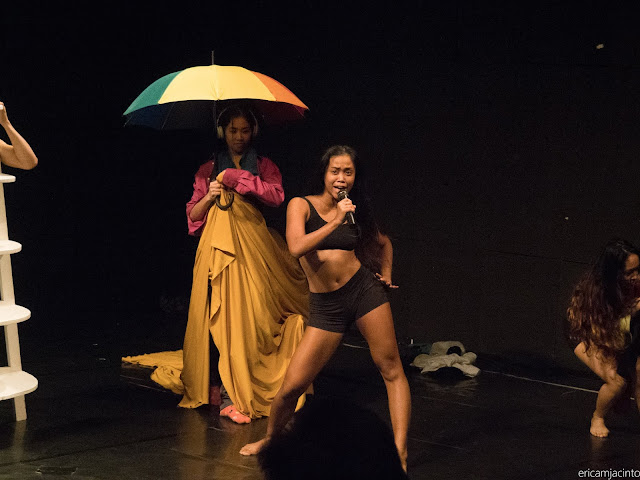


In the very small world of contemporary dance, Korylab is a gift. With access to feedback from CCP's very own greats including but not limited to CCP Artistic Director Cris Millado and founders Myra Beltran and Denisa Reyes, these choreographers had a chance to sink or swim, remain true to their vision or choose to be blurred, remain unapologetic or apologetic about their work. In addition, on the back end they were provided by a lighting team  (Katschthelight) who actually cared about adding value to the pieces. In fact the collaborative energy allowed light to dance with the dancers harmoniously  .That kind of environment I  believe is an awesome training ground for the life as an artist. The result of the exercise as it is coined lab work, will never be futile because it is the output of the mind, body and heart speaking. It is the accumulation of ideas performed earnestly by a cast who believed in the process. Regardless of audience opinion (including mine), their statements will always be VALID. As the directors themselves have said (and I completely agree), their presence before the audience makes them luminous and powerful. That to me defines the success of Koryolab. Congratulations to the empowered brave choreographers who embarked in this journey.  May more people recognize them and find opportunities to use them, watch them and support them.  Bravo Filipino.