Showing posts with label ccp choreographers series. Show all posts

Wednesday, October 16, 2019

KORYO + LAB


"To miss out on developing choreographers is to miss out on dance history. Often enough the maker is given secondary position and projection and the stellar dancer hogs the limelight. Should this remain so for long, the choreographic art itself gets encased and atrophied. It might be skillful and elegant but without the dashing waves of the new, it becomes smooth and sleek deadwood on the shore of dance history."

This insightful quote came from dance historian Steve Villaruz. If the choreographer's creative fleshing out of ideas and emotions is an after thought, then the audience misses out on conversations about life. Similarly, if nobody shows up at the theatre, then the conversation is somewhat silenced. While choreographers seem to be powerful visionaries, an empty seat in that theatre can easily paralyze. at a molecular level, their drive to create new pieces. They are human after all. Finding opportunities to stage performances is already a challenge. Crafting something out of nothing is already emotionally draining. After that effort, it cannot be discounted that an empty seat can dim someone's spirit. It is not a certainty but it is a possibility. The less people watching means less people engaging, less people challenging the message, the aesthetic and the construct of the choreographers. What do you think happens when ideas are relayed like a whisper? Not everyone is strong enough to keep a dream afloat when there seems to be nobody listening (or watching). Hence I think platforms like the WIFI Body, Koryolab and Neo Filipino who provide opportunities of growth for choreographers should be fully supported no matter what. The tripartite progression not only highlights the choreographers' skill, they acknowledge their voices and push for broadening of audiences through various ways. These projects ensures that the skill of creating is harnessed and cared for. So I encourage those who see imperfections on its execution to see that gleaming redeeming factor. Perhaps, a non deserving choreographer chosen can come out better out of the exercise. Perhaps, someone who has entertained the concept of quitting, will be encouraged to create some more. Perhaps an underdog, can surprise people with something mind blowing. Anyway, a couple of hours in the theatre is never unrewarding. Dance while it is governed by social norms like politics, rules, massive followings will come out as a product of the human mind that surely will appeal to someone out there. Time spent will surely be worthwhile.

That being said, I made it to the theatre last August 24, 2019 in support of Koryo Lab where major players in contemporary dance were ably represented. Dingdong Selga, Michael Barry Que and Sarah Samaniego are alumni of UP Dance Company. Buboy Raquitico Jr. is currently dancing for Daloy Dance Company. Christopher Chan is from Airdance.

Buhay Pagasa (House of Hope)
Choreography by Dingdong Selga
Music: Matmos, Olafur Arnalds


Dingdong Selga's brand of  emphatic choreography reminds me of "Humans of New York", a page that shares remarkable stories of people you've never met. The stories they share are shocking, tear jerking, offensive but at the end of the day their stories represent stark realities that nobody considers in their daily lives. In this edition of Koryolab, Selga's "Bahay Pag-Asa" shows the backstory of children who serve time in correctional facilities. There was nothing remarkable about his day-in-a-life story-line. It was moments of the day, thoughts of the day, laughs of the day but it was piercingly profound. Selga in his fifteen or so minute piece was able to discuss the irony that "Bahay Pag-asa" which translates to House of Hope robs children of a future. The piece began with three dancers cramped in to a cell. Struck with boredom the three engaged in sharing of corny jokes emphasizing the repetitiveness of their lives. Same, jokes, same people, same cell. The audience responded to their jokes and the shared laughter momentarily relieved their haplessness. It doesn't last long, because they are interrupted by imaginary caretakers who elicited fear and panic in them. It is at this point that Selga begins to unfold the harsh conditions that the children have to live with. They struggled to make it to the food line. They did hard labor, cleaning and scrubbing. They were silenced with brutality. All of which were done in stylized pedestrian movement with a predominant rhythm to it. The "children" in the harshest conditions thrived by sticking to each other like family. The were all going to be ok because they had each other. One of the dancers was told he had a visit from his mom. In a child like manner he looked into the darkness and waited patiently with eyes watching out for miracle. All of a sudden the solid upbeat vibe transcended into fluid melancholy. Kirby proceeded to perform a solo eliciting tears as he explored the human connection of motherly embrace and child's longing. While this is happening, a pas de deux ensued at the background framed by the steel bars. The remaining two children looked enviously at what they didn't have, love. They only really had friendship, nothing else. When the solo is over, his solace was disrupted by his friends who reminded him that all good things (at least for them) come to an end. The three go back to their prickling life where all their rights are taken away from them. The child's right to education, the right to be safe, the right to play, the right to be heard, the right to have healthcare, the right to food and water all taken away, supposedly to give them hope for a better future that seemingly will never exist. The message of this piece is achingly beautiful. It's a sad  reminder of how adults have lost touch with the important things in favor of structure. The status quo provides no hope, but we can always change the status quo right?

What was beautiful about Selga's work was how he sensitively captured the plight of the condemned children. It seems he really took the time to step into their shoes and understand how it is to live a life without hope. As choreographer and director of his piece it was evident that he communicated this well to his dancers,  Alexa Torte, Daniel Nagal and Kirby Terraza. All three dancers became colorful but broken souls. Their soulful interpretations had layers veering away from a mere comical performance. As a choreographer, Selga's brilliance is in the way he transforms the mundane actions into aesthetically beautiful movement. His work was far from pretentious or overbearing. It was not about him but about the children. HIs focus and pure mindset allowed the storytelling to become magical. Selga seems to have a preference for usage of props. In this piece he used the bench to transition and or introduce his mini vignettes. It was a person, it was a toilet, it was a bench and many more. The dancers handled the prop seamlessly and this says a lot about the preparations going into the show. Easily a crowd favorite, "Bahay Pag Asa" was a success in construction and in concept, social relevance and performance. Tears fell not just because of how emotional the piece but because a choreographer cared enough to tell this story.


Dos Mil Diecienueve Porsyento
Choreographed by Michael Barry Que
Video Projection: Aisha Polestico

This piece presented by Que is not a new piece. It already premiered in the WIFI Body as his graduation piece.  I thought it was quite gracious of Que to explain that he stood by the decision of his mentors when they said "Instagram" (which was the piece that he worked on for KORYOLAB) was not appropriate as of the moment. However, as an audience member who is interested in new works, I was extremely disappointed. Root word being KORYO standing in for choreography and LAB which means laboratory, I thought it was perfectly ok to fail at the experiment if that is what it meant to push the choreographer forward. Good and bad feedback is always valuable to the creators. I believe I echo some of his avid fans. That being said, I applaud Que for his utmost respect for his directors Myra Beltran and Denisa Reyes. While his new piece was not showcased, the presentation of his "Dos" was still beneficial to him as it reaffirmed his status as a choreographer. As he himself said, even if "INSTAGRAM" failed to make in onstage, the mentorship taught him all about the reality of deliverables.

The piece is about  the blurring of identities as our fast paced world demands adults to be a clone of ideal individuals. I have already previously lauded this piece for its strong aesthetics. For this showing, Que chose to add some elements to the choreography. The art of light, leveled up the kick of flavor to the dancing. Shadows were more prominent, and more dancer focused especially in the diagonals. The execution of the hangers coming down from above was cleaner and less screechier then before. Visually, the original parts were dramatized better. To be honest I did not see the necessity for the additional parts and music. I thought the concise version was more effective. Disappointment aside, I believe Que will emerge as a visionary choreographer one day because he pushes his creativity to the limit differentiating his style from others. Perhaps not all his works will be a hit but surely, they will be all be innovative.


Alala
Choreography by Sarah Maria Samaniego 
Music by Meredith Monk and Matmos 

In contrast to the very colorful pieces presented in Koryolab, Sarah Samaniego chose to present a very internal perspective. Her style was not ostentatious, instead it was more like a slow burn demanding you to be patient as she herself told her story. Alala means memory and as far as the dancing is concerned this was quite clear. Samaniego playing the central role, looked back at  her childhood days tracing the body that used to be with her fingers and with her body (another dancer, Katherine Sabate). She examined her old life remembering the highs and lows until she meets a turning point, the present. I appreciated the movement especially because Samaniego is a superb dancer. However, when I read the programme, I thought the explanation did not quite translate on stage. Aside from the huge set, the concept of the paper dolls was overshadowed and became a mere prop to signify childhood. I didn't see how it was meant to shape, duplicate and destroyed. The piece simply but elegantly became a reminder that  sometimes you lose a little of yourself along with your memories. It was a wake up call that  memories are important to keep you whole.


Met-ta-li-tic
Choreography by Christopher Chan 
Music by Jarred Pinto, Iguan, Judith Weir, Jason Lescallet, Meta Gesture Music, Chunky Move

Many have seen Christopher Chan's choreography for Airdance Company. Unfortunately for me I only saw his works at the WIFI and in both cases he was the dancer. It was a refreshing  experience to see  two male dancers give life to his vision. I was pleasantly surprised that Brian Moreno and Joshua Bajado too could perform his brand of tantric body movements including fabulous arm balances complicated by the usage of chairs. The physicality and athleticism were breath taking. 

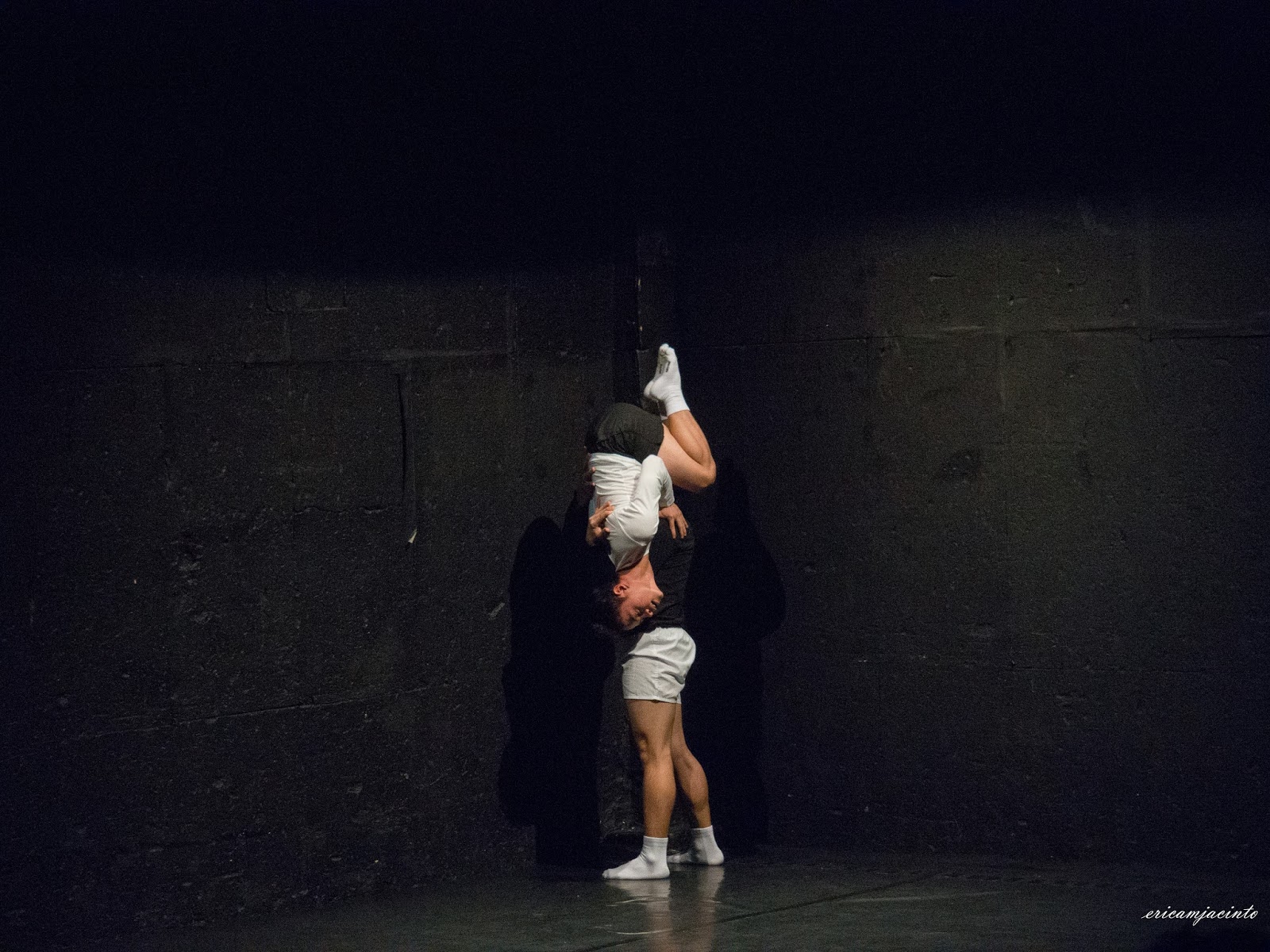
 His theme was technology and this was evident in the execution. Despite the limitations of the blackbox he used projections directed at the floor to simulate how individuals now live inside the box of virtual living. He had two bodies as virtual selves dressed darkly and the main character was dressed in white. Ian Tiba who played the soloist danced in the middle of the stage with the video projections projecting on his skin, he was clothed in  virtual reality. They would often dance in unison or in canon establishing  the unity of the bodies. Most of the choreography made use of their metallic chairs implying they were stuck in their chairs as technology usually straps us all down. At one point Tiba sets in to movement alone in the chair performing Chan's brand of movement being all consumed by the stress of life. As he struggles the two dark bodies further smothering him to a point of asphyxiation. The trios bodies intertwining making it hardly recognizable which body was which as if to imply that the influence becomes truly embedded in oneself. The individual forgets which is influence and which is his or her own thought. Mettalitic was dark and broody much like who we all are sometimes or who who most have become. It's timely and a good representation of current life.


Mano Fracture
Choreography by Raul "Buboy" Raquitico Jr. 
Music: Harold Andre' Cruz Santos


Mano Fracture was surprisingly uncharacteristic of Buboy Racquitico Jr. As his write up clearly says he is a self confessed compulsive thinker. My initial impression of him when I saw "Transacting Comfort" was that he was incredibly precise as a dancer and as a choreographer. He seemed to be quite meticulous in threading together his statements in the form of movement. Mano Fracture was very entertaining with lots of bits and pieces that are largely memorable. Who can forget Deborah Afuang belting out "Basang Basa sa Ulan" while splitting  and undressing?! Who can forget the lingering jingle of "Here at SM, We've got it all for You"?! However I think the message of his piece was a bit muddled. I reckon a lot would like this piece because it the framing was familiar but I guess I was looking for something deeper. I'm not quite sure but Mano Fracture seemed to be about inclusion. How a lurker (played by Brian Abano) with no economic power could or couldn't be welcomed in a capitalist society. The first scene showed a mall opening with guards screening who could come in and Abano was always filtered out. It progressed into a sale, again Abano was pushed out. It transformed into a food court, again he was discriminated. The cycle goes on. However, there was Abano's character through no fault of the dancer does not develop. As the piece was nearing the end I could no longer remember what he symbolized. Was it a character who was indifferent to the discrimination? Did he want to defy it? I thought that with Abano's technical arsenal, he was underutilized. I do however recognize the creativity and entertainment value of the piece. Raquitico is a very intriguing person with a whole lot more to offer in the years to come.


In the very small world of contemporary dance, Korylab is a gift. With access to feedback from CCP's very own greats including but not limited to CCP Artistic Director Cris Millado and founders Myra Beltran and Denisa Reyes, these choreographers had a chance to sink or swim, remain true to their vision or choose to be blurred, remain unapologetic or apologetic about their work. In addition, on the back end they were provided by a lighting team  (Katschthelight) who actually cared about adding value to the pieces. In fact the collaborative energy allowed light to dance with the dancers harmoniously  .That kind of environment I  believe is an awesome training ground for the life as an artist. The result of the exercise as it is coined lab work, will never be futile because it is the output of the mind, body and heart speaking. It is the accumulation of ideas performed earnestly by a cast who believed in the process. Regardless of audience opinion (including mine), their statements will always be VALID. As the directors themselves have said (and I completely agree), their presence before the audience makes them luminous and powerful. That to me defines the success of Koryolab. Congratulations to the empowered brave choreographers who embarked in this journey.  May more people recognize them and find opportunities to use them, watch them and support them.  Bravo Filipino. 

Thursday, November 9, 2017

Creativity Thrives at the Koryolab


Andy Warhol, the famous artist once said that "Everything has its beauty but not everyone sees it". While there is a whole lot of truth in that, more often than not, people don't get the chance to see beautiful things because of the lack of opportunities. Thankfully there are visionaries like Myra Beltran and Denisa Reyes who have made it their advocacy to demand creativity from the new generation of aspiring and existing choreographers. Beltran and Reyes are responsible for the birth and sustained wind of Wifi and Neo Filipino. They have both continued to support the CCP Choreographer Series (a three part platform that combines Wifi Choreographers Competition, Koryolab and Neo Filipino). This year Koryolab was launched, five promising choreographers were given grants to create work under the watchful eyes of dance influencers (Nes Jardin, Steve Villaruz, Myra Beltran, Denisa Reyes, Katsch Catoy). Aside from this, the mentorship included sessions with different audiences who gave their feedback about their work in progress. The intention clearly was to refine the skill of solidifying concepts with more purposeful choices in movement. 

Nothing/Special was Special

JM Cabling gave autism a voice when he chose to present "Nothing/Special".  What was exceptional about this piece was that it stayed far away from disability stigma.  With so much care and attention, he presented a perspective often overshadowed. Autism is not a disability, it is a special enduring ability.  Featuring dancers Marvin Lozana and Kirby Teraza he brought forward ideas often forgotten by many. The piece started with both dancers exploring their own space with unrelated choreography. At some point I started  wondering if they would ever relate to each other. I waited and enjoyed the freedom of movement that made use of the floor, the walls, their clothes and even their body parts. While one was stationary, the other was rolling, lunging, rolling travelling freely. Despite the disconnect in movement, they coexisted beautifully, it was like watching two children exploring a playground. Their movement not one bit tainted with any stigma of disability except maybe the stoic eyes concentrated in their imagined matter. They quickly established they were playing in two different worlds. Eventually their two worlds connected and a bold statement unraveled. As soon as the two dancers found each other and stepped into a  united rhythm. They committed to an unconventional friendship of sorts, never really doing anything in complete unison but always with a sense of togetherness. The two dancers did athletic lifts and supported extensions. There was a lot of push and pull, action reaction contact that emphasized sharing of something real. Particularly memorable to me was when Lozano supported Teraza as he defied gravity and walked on the walls reaching out for something. At a certain point they lost contact and started moving in their own space and direction but Teraza in movement calls out and Lozano looks back, recognizes he is needed and holds him again. The piece ends with both of them finally moving and looking at one direction. Despite the very brawny contemporary vocabulary, the piece reduced me to mush because it represented autistic people so eloquently. Autism is often times regarded so negatively gives a person the ability to do more than the regular joe. Autism defies every concept we were taught. It defies gravity, borders, limitations. It even defies goodbyes. Autism despite struggles allows people simultaneously see more and be more. The dancers in the piece found each other even if it was a struggle but when they did, they were enriched by the both worlds they now see and move in. The message is poetic. The process (as perceived by me) was poetic. Cabling succeeded in creating imaginative sketches that mean something. Whether I captured his intention or not is irrelevant because I see something colorful that I never really took the time to find.


Onus 


Onus is defined as a burden. Jed Amihan wanted to depict the struggle of individuals to survive with the burden of society's demands and commands. His piece is straightforward contemporary in form. A woman is basking in her solitude but is disturbed by menacing voices and bodies. The four bodies took turns moving her, bending her, lifting her. They surround her until they reach the pivotal moment of the piece. Reminiscent of the traditional "Thousand Hands" dance from Thailand, they assembled into a line with the woman in front. They morphed into one body and launched a series of movement in canon with the woman being thrust into different directions. The repetition was effective because it was precise and the continuity was reflective of how society's influence is unending. While I appreciated the visuals and dramatics there were a few things that distracted me a bit. I wouldn't say they were detrimental to the piece but it did leave a few questions in my head. At one point in time one of the dancers Christoper Chan who was part of the ensemble became more  prominent than the others and so it left me questioning why one part of society was stronger than the others. I also didn't quite understand why he was dressing up (or undressing). Contemporary is abstract and perhaps there is another layer of meaning that my mind was not able to comprehend properly.


Misplaced Postcard 

Russ Ligtas' Postcard was intended to be a visual commentary and it was. It was a colorful display of everyday life. It was quite literally a postcard, a picture of different personalities that people might not be thought of or cared for. It reminds me of how callous and self centered people have become (including me). I do however find that the piece was more performance art rather than exploration of dance and therefore a bit misplaced.


Ethnic Tributes in Millenial Bodies

Al Bernard Garcia's "Haya" (To let be) has ethnic references which I have a tendency to love. His piece is about the passing on of a heritage. The black box was turned into a set using lights that painted a picture of a house. I thought it was quite clever as it quickly established that on stage was a community and that was their communal space. The dance was all about symbiotic relationship of all the dancers. They were either dancing in circular fashion, dancing in unison or dancing in one line of sight. It was as if they had their own rituals or traditions that just kept on going on and on with a sense of normality. Like a cycle of life, birth, struggle, moving forward, moving on. That's one of the things I like about his piece, it depicts a picture of ethnicity in a somewhat millennial point of view. While the movement was engaging, I found that the dancers lacked the maturity to really give depth to the piece. It lacked the highs and lows that are imperative in sending a message. I think with more discussion of what their assigned movements are, the real intentions would be revealed in a stronger more imposing manner.


Black Out

Byuti Balaga's piece is about sexual molestation. I honestly did not quite get that at all until I re-read my blogpost about what they said about their individual pieces. Balaga performed the piece herself dressed in a short white dress crouched down holding a rose with the screen showing an old tv screen. She is then joined by four greasy shady looking men in white briefs looking at her salaciously. What follows is honestly quite a jarring experience. The men take turns throwing her to the ground in different ways done with different blocking. She steps towards them and falls to the ground abruptly. This continues for a good five minutes. I found myself completely forgetting the point of the movement because I was so concerned for her health with the repetition of the painful descent to the floor. They also had another round of falling when the men were in table top yoga position and Balaga steps up on their legs one by one and again falls repeatedly to the ground. The piece ends with the men trying to kiss her in her neck one by one with Balaga avoiding the contact. Visually memorable was the scene where the men hold on to the ends of their braids mimicking the "evolution of man" image. The final moments have the men all try to kiss her at once and the lights black out.


Budots Authenticity

"Pidots" choreographed by Erl Sorilla is a product of a great mind. His progression as a choreographer is fast. His pieces are noticeably nicely differentiated from each other. Each piece stands on its own whether it is a quick solo, a duet or an ensemble performance. More importantly, he has not paused. Just this year alone I saw a total of four new very concrete pieces. Each piece reflected totally different points of view from the simple Filipino, to the art connoisseur, to the spiritual community. It's actually exciting watching out which aspect of the Filipino will he choose to play with.

Pidots was a cinematic take on "Budots" which is a slang term for jobless people who hang out because they have so much free time. Apparently Budots is quite a big dance phenomenon in the regionals that is in itself a hybrid of a Badjao tribal dance and and hip hop. I didn't know about this when I watched the Koryolab showcase and was blown away by the accuracy of the Budot craze incorporated in his piece. His dancers could very well be Budots from Davao. The resemblance in movement is uncanny. Sorilla just used the Budots as his medium to tell a more prevalent story because his piece was so much more than replicating the basic movement. His piece started with darkness drawing silhouettes of six people. Then the light hit and revealed bums with very realistic costumes depicting homelessness really. The ensemble sit together with their back on the walls doing nothing until they transition to even more recognizable pedestrian movements. Budots troop, walked together, mumbled together, grunted together. Eventually they were seen mimicking senseless drug use for entertainment. With the drum beat and techno music, the re-imagined but strangely authentic Budots dance craze was depicted in a club scene. Hazardous to the eyes but largely contributory to the aesthetic were the club lights that would shift from color play to singular spots featuring the effect of the drugs in realistic movement. It was as if I was watching a movie with the camera panning and settling on a subject via zoom in to short frame. Then came the spew of Duterte's dirty mouth saying his profanities against drugs. Unperturbed the Budots carried on with their casual entertainment. A spotlight hit their faces signalling a conflict and chaos unfolded. Before they knew it a friend was seen in apparent danger with his eyes blindfolded and his body pushed to a corner. In a dramatic ending everyone else shouted out for him. Their voices were silenced by a gunshot. The story ended with darkness.  As I said previously Sorilla has a million ways of expressing himself. Devoid of any recognizable classical or contemporary technique, he was able to put together movement in a fluid meaningful narrative. It's funny because if I saw a Budot out there sniffing drugs I would probably run away in an instant.  I would probably go all Duterterd and say a handful about "DO NOT DO DRUGS.STOP IT". But his piece humanized them. It was a reminder that they are people just like us who laugh at the silliest things, who dance... who love. There was a quick ache in my heart as it seemed all too real to me. What if it happened right in front of me? What then?! Truly, the impact was strong. I would have to say his dancers should be commended too for their commitment to the role. Ballerinas and danseurs as Budots were quite an impressive transformation. Convincing it was! Important it was!


The Black Box seemed to be fertile ground for the choreographers as a varied display of movement was shared with the audience that day. Nothing was redundant. It reflects the capacity of the choreographers create works that are distinctly unique and personal to them. Similar to a good cup of coffee paired with awesome conversation, shows like this fill you up with things to ponder about (google about). I look forward to more conversations.


Aug 26,2017
2pm and 6pm
CCP Studio Theater (Tanghalang Huseng Batute)

Thursday, August 24, 2017

New Moves from the New Movers: KoryoLab 2017


A blank stage  is like a pure white canvass waiting for  the brushstroke of colors. It is like a blank piece of paper with a question waiting to be answered. To some the, nothingness can be intimidating but to creators of art it is simple a long luxurious exhale. CCP Choreographers Series is all about providing  choreographers of different levels a chance to breath and express themselves. It is a three part platform that seeks to encourage the act of creating art of movement.  The Wifi body.ph is a competition for emerging choreographers, the Koryolab is a presentation of short but completed dance pieces by mid-career choreographers and Neo Filipino is a venue for established choreographers to create and stage major works. 
This weekend Koryolab 2017 will present six bold new works from a diverse group of choreographers . Despite  having different backgrounds, there is a cloud of likemindedness in this group. Perhaps it is their work ethic or their sense of responsibility that  makes them  collectively a group I would call a brotherhood of movers.   

After undergoing mentorship from some of the best industry they will put color on their stage expressing their individual state of mind. Check out what they have to say about their pieces captured from their page CCP Choreographers Series Page

ALL REHEARSAL PHOTOS BY MICA FABELLA 


"I feel like [through KoryoLab] I'll be having a larger audience and with that opportunity, I feel like I should be saying something more pressing, saying something about issues that we are really facing." - Russ Ligtas, last March, KoryoLab 2017

Russ Ligtas' "Postcard" is an offshoot of a solo performance of his, entitled "Letters from Manila." An approximation of a performance artist’s daily reverie conjured by the sunset at Manila Bay, "Postcard" is a visual commentary on one of the heaviest issues in today's socio-political


"Right now, I want something different. [I've been looking at] "Budots"? Something Filipino. I like mirroring Philippine society. [I want] something sarcastic, something that the audience can think about." - Erl Sorilla, last March, KoryoLab 2017

Erl debuts "Pidots", a play off the the term "budots", a slang word for bum Filipino people having no jobs in the slum. The dance is based on the innate tribal movements of the Badjao community, one of the indigenous tribes that remain marginalized with lower wage, higher rate of unemployment, and less access to education, leading to high crime rates, rape cases and teenage pregnancy. The groove within Pidots depicts the setup of the Filipino mentality of just going with the flow, no matter what has the government has done or what life has to offer.


"I'm not letting go of my folk dance and contemporary dance roots. But this time, I'd like to add more layers to the movement." - Al Garcia, last March, KoryoLab 2017

Paying tribute to his folk dance roots, Al Garcia presents the neo-ethnic piece "Haya" for KoryoLab 2017. A word which means "to let be", "Haya" tells of the cycle of life and the passing of history and culture from one storyteller to the next.


Every time I see [special children] dancing, I get very interested. I want to know how they perceive music, how they perceive movement, lines, circles..." - JM Cabling, last March, KoryoLab 2017

JM Cabling's fascination with the world of autistic children inspired him to create "Nothing | Special." As part of his research for the piece, JM spent a lot of time with gifted marimba major from the UP College of Music, Thristan Mendoza.


"I want to play with rawness and technicality. [I want to explore] images that create another perspective." - Jed Amihan last March, KoryoLab 2017

Jed Amihan's exploration has led him to create "Onus," an abstract interpretation of how society manipulates our mind, blurring the distinction between true and false, bad and good.


"Sometimes, we as artists show the people what is happening in society, yet sometimes people are in denial. It's very wrong... The issues must be told, through videos, music... Why not through dance?" - Beauty Balaga last March, KoryoLab 2017

From this initial idea comes Beauty's "Dili Jud Dulaan (Definitely Not A Toy)", a work stemming from the 2015 news of a horrific and controversial video featuring a young toddler named Daisy.


New art is always exciting. Let's all be part of their journey and digest their point of view I can't wait for them to fill  the emptiness with something  to remember and think about. 

KoryoLab 2017
Aug 26 and 27
2pm and 6pm
CCP Studio Theater (Tanghalang Huseng Batute)
Tickets are at Php300 each. For inquiries, please call the CCP Box Office at 832-3704 and TicketWorld at 891-9999 or visit https://www.ticketworld.com.ph/Online/Koryolab2017.