Showing posts with label Erl Sorilla. Show all posts

Wednesday, August 20, 2025

A Season of Gratitude for ARDP


Alice Reyes Dance Philippines (ARDP) opened its 2025 season with Pagdiriwang (Celebration) in April. On August 1, 2025, they followed this with a pre-opening show at the Rockwell Proscenium Theatre featuring Pasasalamat (Thanksgiving). Reflecting on both shows, I realized that this company has made remarkable strides.

In just three years, ARDP has successfully regained ownership of its previous repertoire from Ballet Philippines by performing these pieces under the new company. It now boasts a diverse collection that includes some of the most significant works in dance history, featuring pieces from renowned choreographers such as National Artist Agnes Locsin, Edna Vida, Denisa Reyes, Gener Caringal and  Bam Damian to name a few. Complementing this treasure trove of classics is a fresh array of new creations from both local and international choreographers. In such a short time, this newcomer in the dance world—led by veterans—now holds a repertoire that represents decades of history. And now, they have opened the doors for creating more new work. Indeed, for ARDP, there is much to celebrate and be thankful for. 


Filipino Narratives on Stage

Mga Kwento ni Juan Tamad by Sorilla offered a refreshing reimagining of the popular Filipino tale. In an effort to capture the essence of Filipino culture, Sorilla included characters from various folklores such as Gamu-Gamu at Lampara, Pagong at Kuneho, and Buwaya at Paboreal. With original music composed by Toto Sorioso and sets designed by Loy Arcenas, he embraced a theatrical approach that encouraged the dancers to step outside their comfort zones. All the elements of children’s theatre were present: interaction, engaging dialogue, overt characterization, and a heroine.

Ricmar Bayoneta as Juan Tamad 


This full-length production, created specifically for students in Grades 1 to 10, brought colorful and imposing characters to life. Despite being well above that age bracket, I found myself giggling at the wit, occasional sarcasm, and physical comedy. I honestly loved the”mababaw” and delightfully corny moments. The company as a whole was committed to telling the story, and together they animated Sorilla’s world.

Ricmar Bayoneta as Juan Tamad was ultra-confident in his portrayal, never missing a beat and always flashing a charming smile at his Maria Masipag, danced by the blooming talent  Karla Santos. Here, Juan is cast as the ultimate underdog—the laziest lad one could meet—who, upon finding the love of his life, seizes the chance to save her family and recover their missing golden coconut. Alongside Matsing(monkey), played by Dan Dayo, they encounter a variety of animals. John Ababon was hilarious as the slow Pagong, while Monica Gana played the self-absorbed Kuneho. She could have easily been given a phone to complete the image of today’s self-absorbed youth, embodying the influencer and the mean popular kid in town. Sprightly and bright, she executed saut de chat after saut de chat,  and grand jetés after grand  jete  with both athleticism and charm.

John Ababon as Pagong 


Monica Gana as Kuneho 


Buwaya was portrayed by Ejay Arisola, whose menacing presence was matched by the scheming Francia Alejandro as the jewel-obsessed Paboreal. Their strong characterizations, paired with Sorilla’s choreography, created a simple but thoroughly enjoyable ballet. This was the first time I saw Sorilla take on something lighthearted, as he is typically a cerebral artist. I’m glad he understood the assignment and delivered with success—much to the audience’s delight.

Monica Gana also created a Filipinana-theme romantic duet danced on flats, entitled Para kay Gabriela. This piece offered a glimpse into the love story of Gabriela( the first Filipina General )and Diego. Beautiful in its simplicity, the duet featured Gabriela, played by Krislynne Buri, whose expressive dancing flowed seamlessly with the choreography. She was dutifully partnered by Renzen Arboleda as Diego. It was frankly too short for me, but it shows promise, a great step forward.


Krislyn Burri and Renzen Arboleda


Works in Progress

Pasasalamat marked the third performance of Bam Damian’s piece C’est la Cie. Unsurprisingly, the program notes listed its world premiere as August 1, 2025. This powerful work has been in constant evolution.

In its initial showing last April, I was captivated by its ability to silence the people. At the end of the piece, I felt a bit conflicted about the piece. With the sea of white costumes and a set without wings, it inevitably evoked memories of Damian’s most famous piece in Manila, After Whom. With some of Damian’s signature moves—such as sliding on pointe and running into lifts—it was easy to understand why some might compare the two. However, when I saw it again at the International Dance Day Ballet Gala, I was struck by how much it had evolved. Movements were sharper, the dancers more fearless, and even the costumes were simplified: the men trading asymmetrical draping for plain white skirts. This latest version left me in awe. It had a new essence altogether. Damian’s refinements were genius. 

The piece begins with a female solo performed by Monica Gana against a backdrop of steel architectural installation. There is no hesitation in her approach; from the first note, she defies gravity with generous leaps and draws in the audience with a radiant smile, as if to declare, “This is our time now—to express, to impress, to captivate.”


Her solo is followed by Renzen Arboleda’s quick, skillful sequence brimming with agility and tricks. Soon, the entire company joins in, plunging into the black abyss of the stage. Damian deceives the audience with a few seconds of classical port de bras before he takes us into deconstructed ballet—drops, swoops, hip swings, flexed feet, and off-balance kicks. It’s a breathtaking showcase of speed, power, and artistic intensity. Watching it, I recognized the company’s respect for Damian, allowing him the freedom to keep shaping the work until he feels it is complete. If my pulse were the measure of success, then this piece was a triumph. I lost my voice screaming bravo to express my delight. 


Honoring Legacy

The second half of the gala featured works by Norman Walker, a celebrated dance educator and choreographer with over 300 creations, six of which were premiered in the Philippines with the help of Alice Reyes: Vivaldi Concerto, Seasons of Flight, Songs, Drones, and Refrains of Death, Summer’s End, Songs of the Wayfarer, and Seraphic Fire—the last premiering in Pasasalamat. With Walker and Reyes’ artistic friendship spanning five decades, there was indeed much to be grateful for.


Also presented was Songs of the Wayfarer, which has become a rite of passage for each generation of Alice Reyes dancers. Originally performed by premier danseur Nonoy Froilan, the role has since been passed down to ARDP Artistic Director Ronelson Yadao and current principal dancer Erl Arisola. Over the years, the work has deepened in resonance. Arisola, who embodies its storytelling with conviction, has greatly benefited from multiple opportunities to work with Walker. He first encountered him six years ago, when the piece was mounted for Yadao, and all participants were required to join Walker’s master classes. This second chance to study with the choreographer gave him an undeniable edge. His performance was moving, articulating the pain of unrequited love with sincerity and nuance.


Seraphic Fire, Walker’s latest addition to his long list of works at age 91, was also performed. While I admired the sophistication of its movement and clarity of form, it was not my cup of tea. The energy and technique were undeniable, yet somehow I was completely underwhelmed. Some passages carried the nostalgia of classic modern dance, with tombelevés on one leg, swinging arms, and swirling formations with “held” port de bras. At the end of the piece, I really could not be transported to the mystical heavens.  There’s a possibility this statement will be bashed by Walker’s cult following, but I really could not see the heavenly angels in the piece.  Still, the piece reflected Walker’s enduring artistry, and it earned my respect even if it did not capture my imagination fully.


A Dance of Gratitude

In the end, Pasasalamat was not just a gala—it was a meaningful experience. For some, it may have been simply a fine evening of dance. But for me, it was a love letter of sorts: a salute to the friendships and collaborations that built the past, a thank-you to the audiences who have remained steadfast, and a bow to the young dancer-choreographers who now carry the flame. Gratitude filled the stage—for what has been, for what is, and for the beautiful future yet to unfold. I could very well be wrong, reading more into a simple program. But if that is the message for this season, then I can’t wait to see more.


Thursday, November 9, 2017

Creativity Thrives at the Koryolab


Andy Warhol, the famous artist once said that "Everything has its beauty but not everyone sees it". While there is a whole lot of truth in that, more often than not, people don't get the chance to see beautiful things because of the lack of opportunities. Thankfully there are visionaries like Myra Beltran and Denisa Reyes who have made it their advocacy to demand creativity from the new generation of aspiring and existing choreographers. Beltran and Reyes are responsible for the birth and sustained wind of Wifi and Neo Filipino. They have both continued to support the CCP Choreographer Series (a three part platform that combines Wifi Choreographers Competition, Koryolab and Neo Filipino). This year Koryolab was launched, five promising choreographers were given grants to create work under the watchful eyes of dance influencers (Nes Jardin, Steve Villaruz, Myra Beltran, Denisa Reyes, Katsch Catoy). Aside from this, the mentorship included sessions with different audiences who gave their feedback about their work in progress. The intention clearly was to refine the skill of solidifying concepts with more purposeful choices in movement. 

Nothing/Special was Special

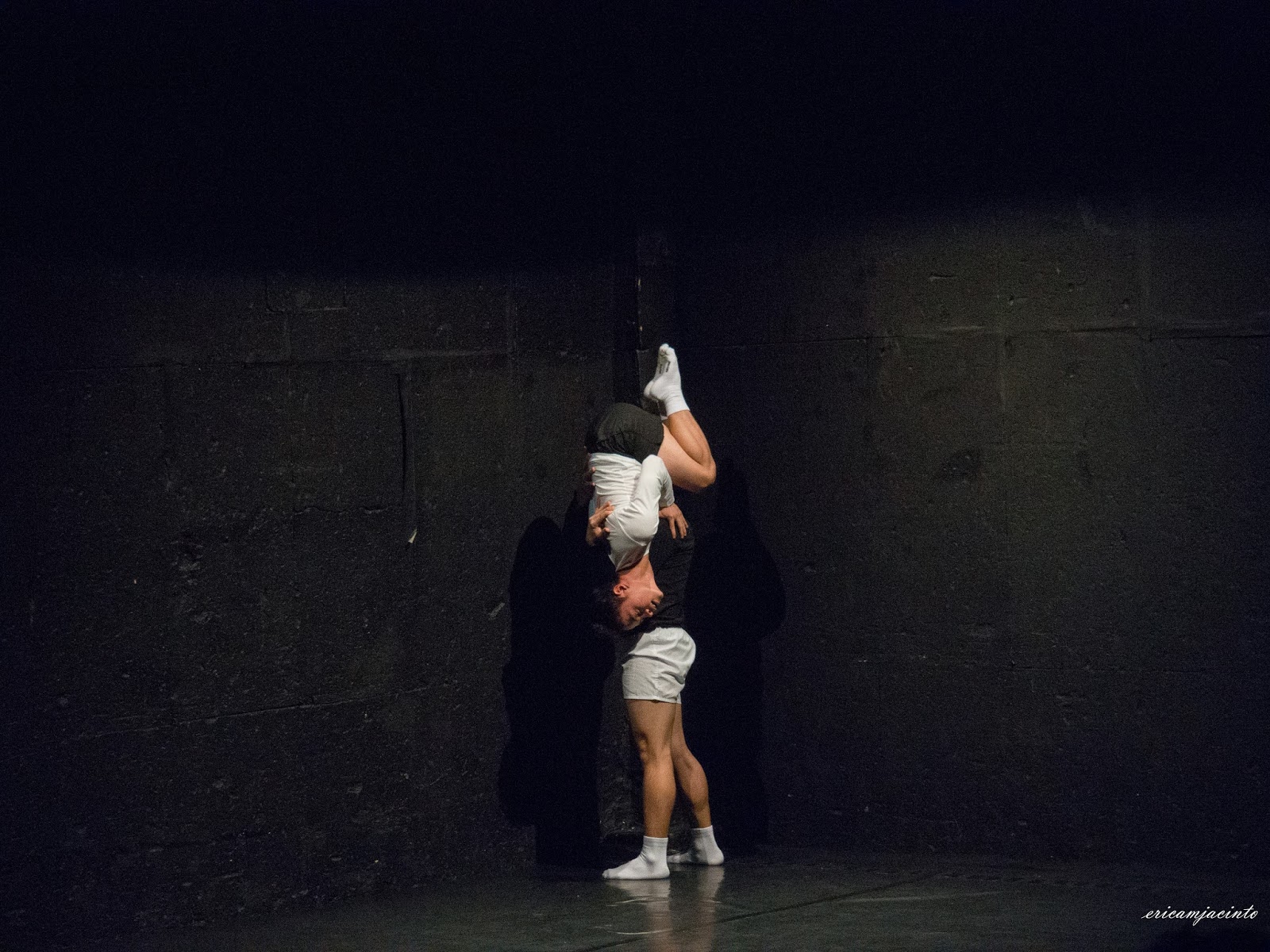
JM Cabling gave autism a voice when he chose to present "Nothing/Special".  What was exceptional about this piece was that it stayed far away from disability stigma.  With so much care and attention, he presented a perspective often overshadowed. Autism is not a disability, it is a special enduring ability.  Featuring dancers Marvin Lozana and Kirby Teraza he brought forward ideas often forgotten by many. The piece started with both dancers exploring their own space with unrelated choreography. At some point I started  wondering if they would ever relate to each other. I waited and enjoyed the freedom of movement that made use of the floor, the walls, their clothes and even their body parts. While one was stationary, the other was rolling, lunging, rolling travelling freely. Despite the disconnect in movement, they coexisted beautifully, it was like watching two children exploring a playground. Their movement not one bit tainted with any stigma of disability except maybe the stoic eyes concentrated in their imagined matter. They quickly established they were playing in two different worlds. Eventually their two worlds connected and a bold statement unraveled. As soon as the two dancers found each other and stepped into a  united rhythm. They committed to an unconventional friendship of sorts, never really doing anything in complete unison but always with a sense of togetherness. The two dancers did athletic lifts and supported extensions. There was a lot of push and pull, action reaction contact that emphasized sharing of something real. Particularly memorable to me was when Lozano supported Teraza as he defied gravity and walked on the walls reaching out for something. At a certain point they lost contact and started moving in their own space and direction but Teraza in movement calls out and Lozano looks back, recognizes he is needed and holds him again. The piece ends with both of them finally moving and looking at one direction. Despite the very brawny contemporary vocabulary, the piece reduced me to mush because it represented autistic people so eloquently. Autism is often times regarded so negatively gives a person the ability to do more than the regular joe. Autism defies every concept we were taught. It defies gravity, borders, limitations. It even defies goodbyes. Autism despite struggles allows people simultaneously see more and be more. The dancers in the piece found each other even if it was a struggle but when they did, they were enriched by the both worlds they now see and move in. The message is poetic. The process (as perceived by me) was poetic. Cabling succeeded in creating imaginative sketches that mean something. Whether I captured his intention or not is irrelevant because I see something colorful that I never really took the time to find.


Onus 


Onus is defined as a burden. Jed Amihan wanted to depict the struggle of individuals to survive with the burden of society's demands and commands. His piece is straightforward contemporary in form. A woman is basking in her solitude but is disturbed by menacing voices and bodies. The four bodies took turns moving her, bending her, lifting her. They surround her until they reach the pivotal moment of the piece. Reminiscent of the traditional "Thousand Hands" dance from Thailand, they assembled into a line with the woman in front. They morphed into one body and launched a series of movement in canon with the woman being thrust into different directions. The repetition was effective because it was precise and the continuity was reflective of how society's influence is unending. While I appreciated the visuals and dramatics there were a few things that distracted me a bit. I wouldn't say they were detrimental to the piece but it did leave a few questions in my head. At one point in time one of the dancers Christoper Chan who was part of the ensemble became more  prominent than the others and so it left me questioning why one part of society was stronger than the others. I also didn't quite understand why he was dressing up (or undressing). Contemporary is abstract and perhaps there is another layer of meaning that my mind was not able to comprehend properly.


Misplaced Postcard 

Russ Ligtas' Postcard was intended to be a visual commentary and it was. It was a colorful display of everyday life. It was quite literally a postcard, a picture of different personalities that people might not be thought of or cared for. It reminds me of how callous and self centered people have become (including me). I do however find that the piece was more performance art rather than exploration of dance and therefore a bit misplaced.


Ethnic Tributes in Millenial Bodies

Al Bernard Garcia's "Haya" (To let be) has ethnic references which I have a tendency to love. His piece is about the passing on of a heritage. The black box was turned into a set using lights that painted a picture of a house. I thought it was quite clever as it quickly established that on stage was a community and that was their communal space. The dance was all about symbiotic relationship of all the dancers. They were either dancing in circular fashion, dancing in unison or dancing in one line of sight. It was as if they had their own rituals or traditions that just kept on going on and on with a sense of normality. Like a cycle of life, birth, struggle, moving forward, moving on. That's one of the things I like about his piece, it depicts a picture of ethnicity in a somewhat millennial point of view. While the movement was engaging, I found that the dancers lacked the maturity to really give depth to the piece. It lacked the highs and lows that are imperative in sending a message. I think with more discussion of what their assigned movements are, the real intentions would be revealed in a stronger more imposing manner.


Black Out

Byuti Balaga's piece is about sexual molestation. I honestly did not quite get that at all until I re-read my blogpost about what they said about their individual pieces. Balaga performed the piece herself dressed in a short white dress crouched down holding a rose with the screen showing an old tv screen. She is then joined by four greasy shady looking men in white briefs looking at her salaciously. What follows is honestly quite a jarring experience. The men take turns throwing her to the ground in different ways done with different blocking. She steps towards them and falls to the ground abruptly. This continues for a good five minutes. I found myself completely forgetting the point of the movement because I was so concerned for her health with the repetition of the painful descent to the floor. They also had another round of falling when the men were in table top yoga position and Balaga steps up on their legs one by one and again falls repeatedly to the ground. The piece ends with the men trying to kiss her in her neck one by one with Balaga avoiding the contact. Visually memorable was the scene where the men hold on to the ends of their braids mimicking the "evolution of man" image. The final moments have the men all try to kiss her at once and the lights black out.


Budots Authenticity

"Pidots" choreographed by Erl Sorilla is a product of a great mind. His progression as a choreographer is fast. His pieces are noticeably nicely differentiated from each other. Each piece stands on its own whether it is a quick solo, a duet or an ensemble performance. More importantly, he has not paused. Just this year alone I saw a total of four new very concrete pieces. Each piece reflected totally different points of view from the simple Filipino, to the art connoisseur, to the spiritual community. It's actually exciting watching out which aspect of the Filipino will he choose to play with.

Pidots was a cinematic take on "Budots" which is a slang term for jobless people who hang out because they have so much free time. Apparently Budots is quite a big dance phenomenon in the regionals that is in itself a hybrid of a Badjao tribal dance and and hip hop. I didn't know about this when I watched the Koryolab showcase and was blown away by the accuracy of the Budot craze incorporated in his piece. His dancers could very well be Budots from Davao. The resemblance in movement is uncanny. Sorilla just used the Budots as his medium to tell a more prevalent story because his piece was so much more than replicating the basic movement. His piece started with darkness drawing silhouettes of six people. Then the light hit and revealed bums with very realistic costumes depicting homelessness really. The ensemble sit together with their back on the walls doing nothing until they transition to even more recognizable pedestrian movements. Budots troop, walked together, mumbled together, grunted together. Eventually they were seen mimicking senseless drug use for entertainment. With the drum beat and techno music, the re-imagined but strangely authentic Budots dance craze was depicted in a club scene. Hazardous to the eyes but largely contributory to the aesthetic were the club lights that would shift from color play to singular spots featuring the effect of the drugs in realistic movement. It was as if I was watching a movie with the camera panning and settling on a subject via zoom in to short frame. Then came the spew of Duterte's dirty mouth saying his profanities against drugs. Unperturbed the Budots carried on with their casual entertainment. A spotlight hit their faces signalling a conflict and chaos unfolded. Before they knew it a friend was seen in apparent danger with his eyes blindfolded and his body pushed to a corner. In a dramatic ending everyone else shouted out for him. Their voices were silenced by a gunshot. The story ended with darkness.  As I said previously Sorilla has a million ways of expressing himself. Devoid of any recognizable classical or contemporary technique, he was able to put together movement in a fluid meaningful narrative. It's funny because if I saw a Budot out there sniffing drugs I would probably run away in an instant.  I would probably go all Duterterd and say a handful about "DO NOT DO DRUGS.STOP IT". But his piece humanized them. It was a reminder that they are people just like us who laugh at the silliest things, who dance... who love. There was a quick ache in my heart as it seemed all too real to me. What if it happened right in front of me? What then?! Truly, the impact was strong. I would have to say his dancers should be commended too for their commitment to the role. Ballerinas and danseurs as Budots were quite an impressive transformation. Convincing it was! Important it was!


The Black Box seemed to be fertile ground for the choreographers as a varied display of movement was shared with the audience that day. Nothing was redundant. It reflects the capacity of the choreographers create works that are distinctly unique and personal to them. Similar to a good cup of coffee paired with awesome conversation, shows like this fill you up with things to ponder about (google about). I look forward to more conversations.


Aug 26,2017
2pm and 6pm
CCP Studio Theater (Tanghalang Huseng Batute)

Thursday, June 8, 2017

Passages


Passages is defined as  the act or process of moving through, under, over or past something on the way from one place to another. Sounds like a simple concept of gravitating towards something. The truth of the matter is the word is as complex as it gets.   When someone moves forward they allow themselves to feel, accept and respond to whatever emotions, opportunities and or obstacles come their way.  Bringing with them what they want to bring from the past, they eventually take the step forward. This Sunday June 11, 2017, BGC Arts Festival will present a  show that intends to share  the art of people who are in passage.  Five dancer-choreographers will present  pieces that represent their artistic journey. (Elena Laniog-Alvarez, Al Bernard Garcia, Erl Sorilla, PJ Rebullida, Dingdong Selga)

Having seen parts of the show, I find that it is one that gives a lot of hope for artists. It is an affirmation that your feet will lead you exactly where you are meant to be. Watch the show and you just might find the inspiration to move forward. 

Have a visual taste. 
All accompanying text are just a play of words and do not necessarily represent the choreographers' point of view. #hugot


Out of the Shadows (Self Titled)
Choreographed by Al Bernard Garcia 
Performed by JM Cabling, Al Bernard Garcia and Rita Winder 

Stepping out of the shadows 
Mind tells you you're alone but the heart knows better.
You move forward but you feel the wind blowing you backwards.
Your body weakens, your heart momentarily stops.
Something, someone steadies your feet
Suddenly you feel the warmth of the light. 
 You're in the light. 
Are you happy now?


 A Cup of Me 
Choreographed by Elena Laniog Alvarez
Performed by Rita Winder and JM Cordero 

Waking up to a new day with an unfamiliar breeze 
Speaking with an unfamiliar tongue
Moving forward unto the maze with unfamiliar uncertainty

Waking up familiar with the once unfamiliar breeze
Speaking comfortably with a familiar tongue
Moving forward passionately to uncertainty

Things change.


Vici
Choreographed by Erl Sorilla 
Performed by Victor Maguad 

I am me
strong yet soft,
masculine yet feminine,
simple but colorful.
Do you love me?
Can you love me?


Inday 
Choreographed by Erl Sorilla 
Performed by Gia Gequinto

Another day. Passing through another day. 


Beautiful Embrace (Self titled)
Choreographed by Erl Sorilla 
Performed by JM Cordero and Erl Sorilla

Sometimes you look at nothing but you see something. 
Sometimes you see something but pretend you see nothing. 


Butter Pls
Choreographed by PJ Rebullida
Performed by Karmela Cortez Jabla, Bianca Perez, Christine Crame  

Is there anything I haven't given you?