
Two years ago, I witnessed the 10th year anniversary of the WIFI which originally was a multi-faceted festival celebrating contemporary dance. In 2016 it was a simplified and straightforward competition that left me in awe. Despite the fact that it did not have its usual frills, it achieved its original purpose which was to broaden the concept of contemporary. The vocabulary was expansive and the articulation varied. I was ecstatic that the template of the previous seasons were blurred allowing audiences to see what contemporary really means. It was a collectively strong representation of the genre. While so many dance icons have defined contemporary dance, the common denominator is that it is an art that is not contained in a particular shape, theme or medium. At the same time, dance is still an exploration of movement. In the past, I would be disappointed that people replaced the action word with bad acting or even worse something that served only as shock factor. Last season's showing was a fitting representation of how far the Philippines has come.
That being said, I had high hopes for this season's new breed of young choreographers.I was eager to find out if the momentum was sustained. Thankfully, I had my fill of good performances from both the competitors and the previous winners. Honestly I did not love everything I saw. There were still a few remnants of the past. However the point of WIFI is not to please audiences like me (It is impossible to please everyone anyway.) The point of WIFI is for contemporary thought to prevail. In this sense, this season just like the previous one moved a step forward. In this year's WIFI, the range of movement or technique for that matter was generally lacking but the conceptual approach of all the choreographers were very impressive. The story telling was not generic. The nuances of the pieces created space for audiences to have fun interpreting the pieces in accordance to their own set of beliefs. In a nutshell, the pieces were alive colored with meticulously planned emotions and references that audiences can relate to. The standard has been set.

Winning the top prize of this year's competition is Raul "Buboy" Raquitico Jr. His piece "Transacting Comfort" was indeed superior to all the other intelligent pieces. He explored the concept of materialism as an addiction and distracting social phenomenon. He himself performed the "body" with dancer Jan Lloyd Celecio as the measure of comfort. Raquitico appeared in the corner with his bare body hunched over. Celecio who was in black in static movements moved towards him revealing a tape measure. In a gentle pas de deux exchange they measured each other. Celecio initiating and Raquitico responding. Celecio dressed Raquitico with a skirt but instinctively Raquitico rejected it. Eventually he obliged and wore the skirt until they danced together with the same breath. Raquitico acclimatized with the presence of Celecio just like a person relies on temporary comforts. He leaned on him, hovered over him, was lifted by him as if he was as necessary as air. However in the end of the piece he returned to being himself, looking at his comforts as a complex creation that was completely unnecessary. He looked at Celecio, his self created monster with the measurements that he thought were sound. In the end, he allowed himself to walk away and Celecio wrapped in tape measure stood there stoically as if his life was thinning out. In solid dramatics, the light dimmed and the tape measure unraveled out of his body with a shrieking sound dancing with the light until complete darkness came. Worthy of recognition was how Raquitico translated such an internal complex concept of mental duality into something very easy understand. The strategic use of props was a winning idea. His calm fluid combinations were very appropriate in depicting his train of thought. Also noteworthy is his use of space. His patterns allowed the audience to really understand the concept of measuring comfort. "Transacting Comfort" was inventive, powerful and engaging.


Second place was won by Jovie Ann Domingo for her piece "Walk Without Pain". Panel judge Tatsuro Ishii said it best when he described this piece as more of a theatrical unfolding rather than a dance performance. He mentioned that the strength of this piece was that it was communicative and emotive. Domingo explored the concept of death with the image of a loved one lingering even as time passed by. In the performance it was unclear to me who was dead and who was alive as they stepped in and out of their respective realms. Dancer Beauty Balaga was in a chair and Ralph Malaque sat in a table. Both executed corporeal movements imitating an unremarkable day made remarkable by lingering memories. They eventually gravitated in the same space and they performed a struggle to let go.

Third place went to "Namoka" a piece created by Sasa Cabalquinto. In the program it says it is an exploration of the individual self. The choreographer performed it herself. She appeared dressed in layers and would play out a different emotion as she took off layers of her costume. While her piece very clearly states it is about a single individual, my take of the piece is a bit different. I would have to refer to the iconic answer of Ms. Universe Sushmita Sen, "Just being a woman is God's gift that all of us must appreciate. The origin of a child is a mother, and is a woman. She shows a man what sharing, caring and loving is all about. That is the essence of a woman.". In blunt imagery the piece depicted the different roles that women in the world have had to take. In sections of her piece she is seen lost, suffering, wanting, crying. In the more powerful moments when she starts undressing, she shows the image of a nurturing mother. She ends the piece with undressed but commanding. The piece to me is about empowered women.


With the competition ending, the festival director Myra Beltran presented with pride the works of the previous season winners.She was hopeful that the performances would show maturity and depth after all the gifts they have received as a result of their win two years ago.
Beauty Balaga's new piece "Opinion is like and Asshole Everyone Has It" was quite a departure from her previous choreography. In a monotonous manner, the dancers came in and followed a straight line opening their mouths as if they were receiving communion or giving confession to a cult pastor in an unthinking manner. They congregated and sat in chairs where they moved in unison as a one body. A girl entered and spoke in sign language and everybody started talking randomly about her. She went to them and was moved by the people without touching her. When she finally ascended they followed her moving around her as she stepped in and out of a chair. Nobody really bothered to save her from falling. At the end of the piece the girl spoke in sign language again but this time beside a girl with red balloons. The balloons burst one by one. Each time it did, a cult member fell down. At the end, the girl left with immobile bodies on the floor. To be honest I thought that the piece would have been more powerful with more technique in the execution. The dancers made up however with a very soulful theatrical interpretation. The storyline was all to too relatable. It clearly explained the indifference of people to the adverse of effect of not sincerely caring about issues. It was a very cutting emphasis that people care more about the story than the person.The girl was speaking in sign language, nobody understood it but dancers articulated their judgement. She went about them and they followed her story but nobody lifted a finger in actually being there for her. They actually let her fall. They just all reveled in their opinions. What was important was that they were spectators of a story. In the end the balloons signified that opinions have the capacity to hurt one or more individuals if they are not shaped with the right intentions. Balaga's approach to choreography has definitely evolved. Clearly, she is now more motivated into incorporating communal interaction rather than a straightforward delivery. I view it positively because her point of view is expanding.


Christopher Chan presented "H2 +1". He showed off his signature movement combining held yogic poses and calculated breaths and explosive dramatics. He incorporated a mix of foreign chatter which I'm sure is a thread of poetic thought. While I appreciated the performance greatly for his abilities I honestly did not understand any of it. I do not discount the art but I did want something new from him.


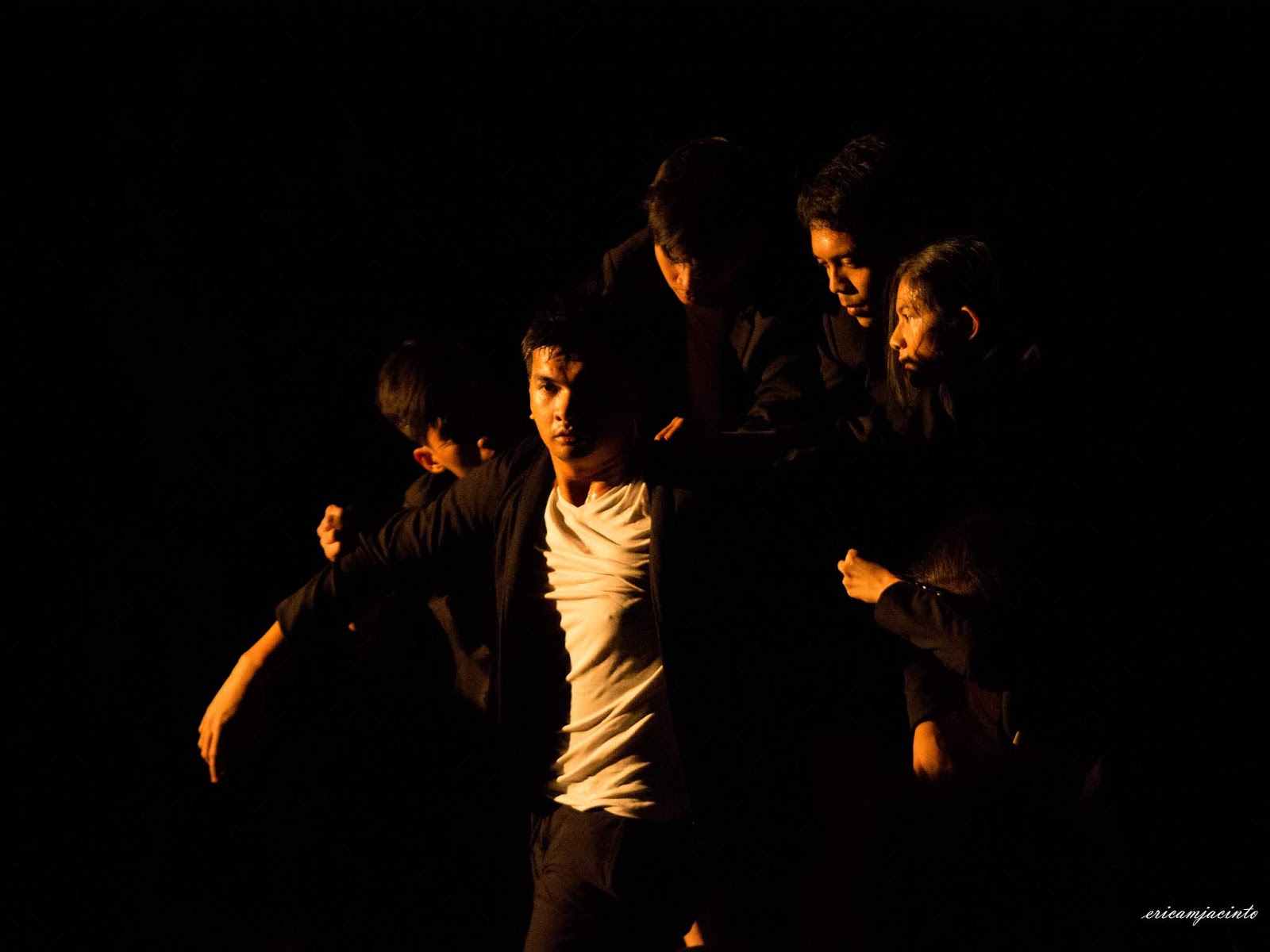
Michael Barry Que's piece is one that I would like to see in a bigger stage. I have to make mention that his casting was quite strategic with some of the best contemporary dancers casted. The mesh of dance experience and innovative spirit was a good mix, something old and something new. Que's set consisted of a clothes line with hangers with black suits. A dancers wears the suit and a few more follow. With much intensity they form an ensemble who dance fiercely interacting in pairs, in groups and sometimes in dancing in quick solitary moments. Together they dance the life of adults. Adulting forces them to contain their individuality in favor of responsibility complying with the demands of society. The hangers remained in the set as a constant reminder that they must be clothed with responsibility. At a certain point all of the dancers take out one by one their black coats except for soloist Al Garcia They remained colorless in white. Garcia is then thrust into a web of white with everyone threading their arms and legs creating a webs of beautiful images. Garcia's coat is discarded but continues to dance but he does so with limited freedom. He conforms to the white movement. For me the message of the piece was brilliantly delivered with a series of rich memorable imagery. Clear as day was the depiction of how adulting dulls lives with the requirement to conform, deliver and succeed. Adulting doesn't end with what society expects, that is just one layer of expectations. Even in your intimate lives there will be other layers demanding a person to conform, deliver and succeed. Perhaps it could come from family, friends, mentors. What is nice about this piece is that it doesn't force a conclusion. It doesn't necessarily portray the extremes of happiness or angst instead it delivers the state of being. For me as an audience, it allowed me to commiserate and I guess think about my own layers. I believe Que is on the verge of unraveling his own layers.


The WIFI Body Competition was meant to be a platform to explore thought and movement in a contemporary manner. The noticeable shift of perspective from creating caricatures to representing actual creatures of God is such a big step forward. The growth of the previous winners is also a big contribution to the dance world. In closing, I encourage all creators to revel in this step forward. Opportunities like the Wifi should be more than just a stepping stone. It should be a moment that helps you decide whether you are an artist or not. The dance world can be cruel. Obstacles and noise will always be there to pull you back. The lack of equal opportunities is also very discouraging. Not everyone will like the works as well. I can only hope that breakthroughs like this remind the artists that to be able to create is a gift in itself. To be able to better yourself is a blessing. But the ultimate reward would be to share it with another human being filling them with a chance to think, imagine and be captivated for a moment in time. May the fight for art be won everyday.


