Showing posts with label dance photography. Show all posts

Thursday, September 6, 2018

WIFIBody.ph 2018; Creatures Vs Caricatures


Two years ago, I witnessed the 10th year anniversary of the WIFI which originally was a multi-faceted festival celebrating contemporary dance. In 2016 it was a simplified and straightforward competition that left me in awe. Despite the fact that it did not have its usual frills, it achieved its original purpose which was to broaden the concept of contemporary. The vocabulary was expansive and the articulation varied. I was ecstatic that the template of the previous seasons were blurred allowing audiences to see what contemporary really means. It was a collectively strong representation of the genre. While so many dance icons have defined contemporary dance, the common denominator is that it is an art that is not contained in a particular shape, theme or medium. At the same time, dance is still an exploration of movement. In the past, I would be disappointed that people replaced the action word with bad acting or even worse something that served only as shock factor. Last season's showing was  a fitting representation of how far the Philippines has come.

That being said, I had high hopes for this season's new breed of young choreographers.I was eager to find out if the momentum was sustained. Thankfully, I had my fill of good performances from both the competitors and the previous winners. Honestly I did not love everything I saw.  There were still a few remnants of the past. However the point of WIFI is not to please audiences like me (It is impossible to please everyone anyway.) The point of WIFI is for contemporary thought to prevail. In this sense, this season just like the previous one moved a step forward. In this year's WIFI, the range of movement or technique for that matter was generally lacking but the conceptual approach of all the choreographers were very impressive. The story telling was not generic. The nuances of the pieces created space for audiences to have fun interpreting the pieces in accordance to their own set of beliefs. In a nutshell, the pieces were alive colored with meticulously planned emotions and references that audiences can relate to. The standard has been set.


Winning the top prize of this year's competition is Raul "Buboy" Raquitico Jr. His piece "Transacting Comfort" was indeed superior to all the other intelligent pieces. He explored the concept of materialism as an addiction and distracting social phenomenon. He himself performed the "body" with dancer Jan Lloyd Celecio as the measure of comfort. Raquitico appeared in the corner with his bare body hunched over. Celecio who was in black  in static movements moved towards him revealing a tape measure. In a gentle pas de deux exchange they measured each other. Celecio initiating and Raquitico responding. Celecio dressed Raquitico with a skirt but instinctively Raquitico rejected it. Eventually he obliged and wore the skirt until they danced together with the same  breath. Raquitico acclimatized with the presence of Celecio just like a person relies on temporary comforts. He leaned on him, hovered over him, was lifted by him as if he was as necessary as air. However in the end of the piece he returned to being himself, looking at his comforts as a complex creation that was completely unnecessary. He looked at  Celecio, his self created monster with the measurements that he thought were sound. In the end, he allowed himself to walk away and Celecio wrapped in tape measure stood there stoically as if his life was thinning out. In solid dramatics, the light dimmed and the tape measure unraveled out of his body with a shrieking sound dancing with the light until complete darkness came. Worthy of recognition was how Raquitico translated such an internal complex concept of mental duality into something very easy understand. The strategic use of props was a winning idea. His calm fluid combinations were  very appropriate in depicting his  train of thought. Also noteworthy is his use of space.  His patterns allowed the audience to  really understand the concept of measuring comfort. "Transacting Comfort" was inventive, powerful and engaging.


Second place was won by Jovie Ann Domingo for her piece "Walk Without Pain". Panel judge Tatsuro Ishii said it best when he described this piece as more of a theatrical unfolding rather than a dance performance. He mentioned that the strength of this piece was that it was communicative and emotive. Domingo explored the concept of death with the image of a loved one lingering even as time passed by. In the performance it was unclear to me who was dead and who was alive as they stepped in and out of their respective realms. Dancer Beauty Balaga was in a chair and  Ralph Malaque sat in a table. Both executed corporeal movements imitating an unremarkable day made remarkable by lingering memories. They eventually gravitated  in the same space and they performed a struggle to let go.


Third place went to "Namoka" a piece created by Sasa Cabalquinto. In the program it says  it is an exploration of  the individual self. The choreographer performed it herself. She appeared  dressed in layers and would play out a different emotion as she  took off layers of her costume. While her piece very clearly states it is about a single individual, my take of the piece is a bit different. I would have to refer to the iconic answer of Ms. Universe Sushmita Sen, "Just being a woman is God's gift that all of us must appreciate. The origin of a child is a mother, and is a woman. She shows a man what sharing, caring and loving is all about. That is the essence of a woman.". In blunt imagery  the piece depicted the different roles that women in the world have had to take. In sections of her piece she is seen lost, suffering, wanting, crying. In the more powerful moments when she starts undressing, she shows the image of a nurturing mother. She ends the piece with undressed but commanding. The piece to me is about empowered women.


With the competition ending, the festival director Myra Beltran presented with pride the works of the previous season winners.She was hopeful that the  performances would show maturity and depth after all the gifts they have received as a result of their win two years ago.

Beauty Balaga's new piece "Opinion is like and Asshole Everyone Has It" was quite a departure from her previous choreography. In a monotonous manner,  the dancers came in and followed a straight line  opening their mouths as if they were receiving communion  or giving confession to a cult pastor in an unthinking manner. They congregated and sat in chairs where they moved in unison as a one body. A girl entered  and spoke in sign language and everybody started talking randomly about her.  She went  to them and was  moved by the people without touching her. When she finally ascended they followed her moving around her as she stepped in and out of a chair. Nobody really bothered to save her from falling.  At the end of the piece the girl spoke in sign language again but this time beside a girl with red balloons. The balloons burst one by one. Each time it did, a cult member fell down. At the end, the girl left with immobile  bodies on the floor. To be honest I thought that the piece would have been more powerful with more technique in the execution. The dancers made up however with a very soulful theatrical interpretation. The storyline was all to too relatable. It clearly explained the indifference of people to  the adverse of effect of not sincerely caring about issues.  It was a very cutting emphasis that people care more about the story than the person.The girl was speaking in sign language, nobody understood it but dancers articulated their judgement. She went about them and they followed her story but nobody lifted a finger in actually being there for her. They actually let her fall. They just all reveled in their opinions. What was important was that they were spectators of a story. In the end the balloons signified  that opinions have the capacity to hurt one or more individuals if they are not shaped with the right intentions. Balaga's approach to choreography has definitely evolved. Clearly, she is now more motivated into incorporating communal interaction rather than a straightforward delivery. I view it positively because her point of view is expanding. 


Christopher Chan presented "H2 +1". He showed off his signature movement combining held yogic poses and calculated breaths and explosive dramatics. He incorporated a mix of foreign chatter which I'm sure is a thread of poetic thought. While I appreciated the performance greatly for his abilities I honestly did not understand any of it. I do not discount the art but I did want something new from him.


Michael Barry Que's piece is one that I would like to see in a bigger stage. I have to make mention that his casting was quite strategic with some of the best contemporary dancers casted. The mesh of dance experience and innovative spirit was a good mix, something old and something new. Que's set consisted of a clothes line with hangers with black suits. A dancers wears the suit and a few more follow. With much intensity they form an ensemble who dance fiercely  interacting in pairs, in groups and sometimes in dancing in quick solitary moments. Together they dance the life of adults. Adulting forces them to contain their individuality in favor of responsibility complying with the demands of society. The hangers remained in the set as a constant reminder  that they must be clothed with responsibility. At a certain point all of the dancers take out one by one their black coats except for soloist Al Garcia They remained colorless in white. Garcia is then thrust into a web of white with everyone threading their arms and legs  creating a webs of beautiful images. Garcia's coat is discarded but continues to dance but he does so with limited freedom. He conforms to the white movement. For me the message of the piece was brilliantly delivered  with a series of  rich memorable imagery. Clear as day was the depiction of how adulting dulls lives with the requirement to conform, deliver and succeed. Adulting doesn't end with what society expects, that is just one layer of expectations. Even in your intimate lives there will be other layers demanding  a person to conform, deliver and succeed. Perhaps it could come from family, friends, mentors. What is nice about this piece is that it doesn't force a conclusion. It doesn't necessarily portray the extremes of happiness or angst instead it delivers the state of being.  For me as an audience, it allowed me to commiserate and I guess think about my own layers. I believe Que is on the verge of unraveling his own layers.
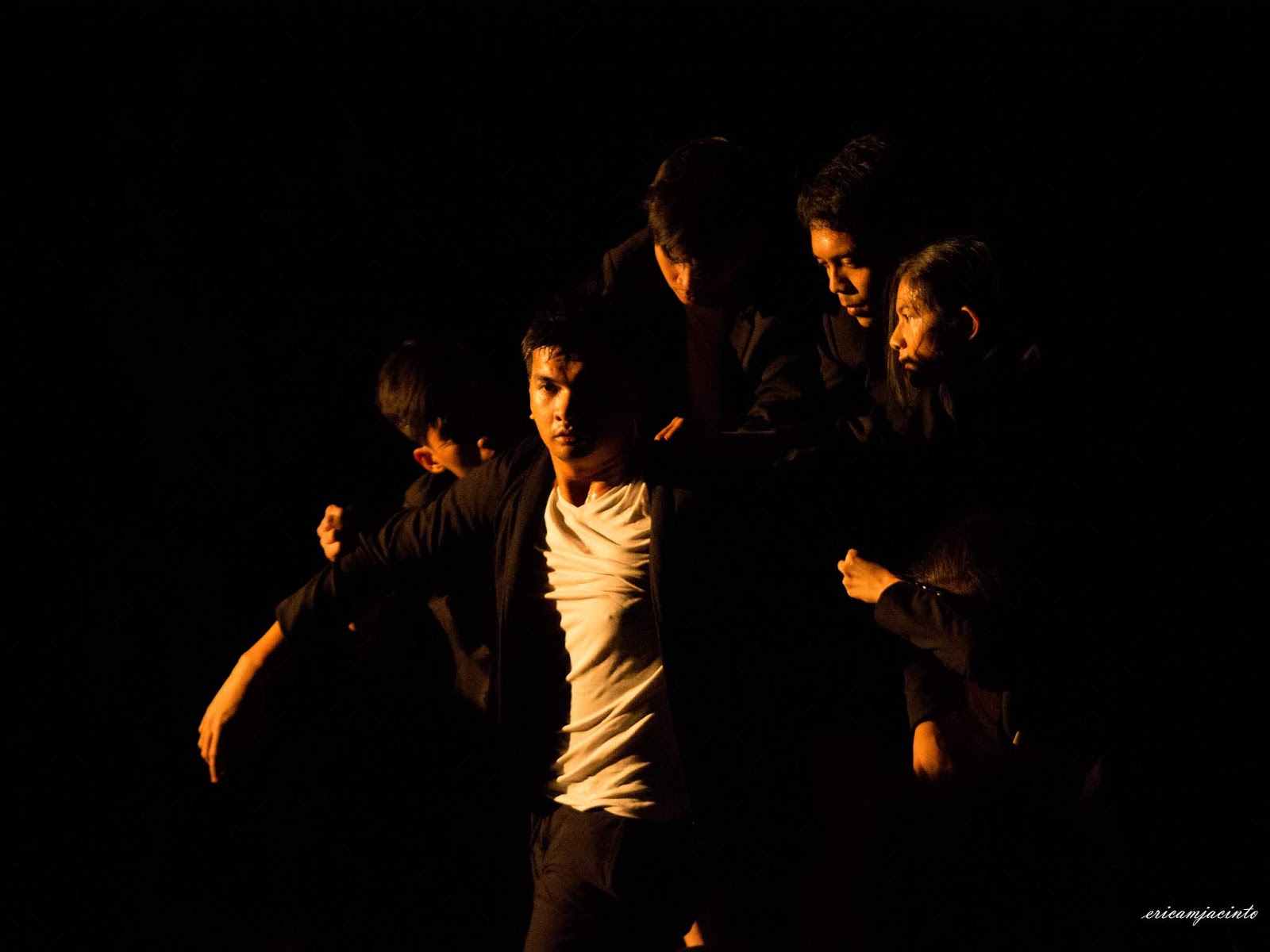


The WIFI Body Competition was meant to be a platform to explore thought and movement in a contemporary manner. The noticeable shift of perspective from creating caricatures to representing actual creatures of God is such a big step forward. The growth of the previous winners is also a big contribution to the dance world. In closing, I encourage all creators to revel in this step forward. Opportunities like the Wifi should be more than just a stepping stone. It should be  a moment that helps you decide whether you are an artist or not. The dance world can be cruel. Obstacles and noise will always be there to pull you back. The lack of equal opportunities is also very discouraging. Not everyone will like the works as well. I can only hope that breakthroughs like this remind  the artists that to be able to create is a gift in itself. To be able to better yourself is a blessing. But the ultimate reward would be to share it with another human being filling them with a chance to think, imagine and be captivated for a moment in time. May the fight for art be won everyday.

Saturday, October 21, 2017

Quintessence, Ballet Philippines' A Gala Celebration


Ballet Philippines opened their season with quite an unremarkable show called "Your Highness"  at the Little Theater.  It was hardly a production  that would   mark the entrance of National Artist for Dance Ms. Alice Reyes as the new artistic director of the Company. "A Gala Celebration" which quickly followed was what fully reflected the changing of the guard. Last August 18, 2017, devoid of any frills Ms. Alice Reyes was officially introduced to the audience as the new leadership. A spotlight hovered over the filled up seats and  she stood up in the middle of the crowd nonchalantly. With a gentle smile and glassy eyes she went on to address the crowd with a speech that was certainly unexpected. As a founder of the Company I somehow expected her words  to be along the lines of tribute to the glory days, direction for the future  or this is Ballet Philippines now.  After all it is with much anticipation that people waited for her hands to once again  touch the company she built. In contrast, she went another way.  She chose to make her first public move a step towards gratitude.  Without further adieu she individually introduced the people sitting in her row. She acknowledged the work  of all other artistic directors  who have contributed  to the survival of Ballet Philippines. She highlighted that the show that we were about to see was a product of continuity and resilience. Her graciousness was heart warming and endearing. It was the that perfect touch that set the mood of excitement not only for the show but for Ballet Philippines' 48th Season labeled perfectly as QUINTESSENCE.  

Neo Classical Gems 

The mixed bill showed a wide range of genres from classical ballet, neo classical and modern pieces. The curtains rose to Ms. Reyes' "Bungkos Suite", a delightfully light  pursuit to give life to Filipino folk music. Just as it has in the past, the quick and easy ballet done on barefoot  played with the usual temperament of the Filipino, naughty and playful.There's  peculiar charm brought about the familiarity to the songs.   This was one of they lighter pieces of the evening. 


Former Artistic Director Bam Damian's " Minamahal, Sinasamba" is  also a tribute to original Filipino music. In contrast it played more on athleticism instead of dainty gracefulness. It dealt with different vignettes of love.  The piece is largely based on a vocabulary of highly technical partnering. Unexpected exciting lifts, turns and quick solos showed off the inspiring bravery of the young bloods performing the piece. The girls took on the tours and the men caught  them in mid air.   Tour je tes  that end in fish dives, classical finger turns  that go from pointe to fondue (bent knee on pointe)  were good twists  to the conventions of ballet. Gasps from the audience could be heard in regular intervals in appreciation for the the dramatics that occurred on stage. 


PHOTO BY JUSTIN BELLA ALONTE 
                           
Norman Walker's  "Summer's End" is one of the classics I have not seen  before. Without any tinge of expectation I loved the serenity of the piece.  Chopin's music was translated into an unpretentious romance. Real life lovers and principal dancers JM Cordero and Rita Winder impressed me with their flawless partnering. The choreography itself is beautiful but there is a noticeable tranquility as they executed partnered extensions. Their sequences seemed to always end up with a luxurious embrace and the fluidity was soothing to the eyes. More than their solid technique it was their openness to tell a story that was a refreshing. Both dancers who were set to leave right after the performances to their new career destination seemed committed to making their last performance something to be remembered. The end of a romance , the end of a journey was anything but bittersweet.


The Classics

Ballet Philippines made sure they included the classics. Victor Maguad and Jemima Reyes starred in the highly technical Grand Pas Classique. Maguad displayed his usual flexibility and Reyes gave her all to her difficult fouettes and turn combinations. Everything was good but this ballet to me is very static with no highs and lows. My appreciation is limited to how good the dancers are.  


Raymonda was more entertaining. Guest Principal Candice Adea led the pack with her movement imbued with  rich elan. Every bit the performer, she marked her steps soulfully. Despite her dreary mustard costume  she still came out  as the bejeweled star of Raymonda. There is much maturity in how she articulates her body and her emotions. Guest Artist Marcelino Libao who partnered her enjoyed his moments on stage .His commitment to style makes him unique. 


Modern Greats 

Krisbelle Mamangun gave life to Agnes Locsin's epic "Salome" This piece that has gained international recognition in the past still comes out strong after all these years. Deeply rooted to emotion a very mature dancer mesmerized me with her impeccable strength and control. Memorable is her slow as death hinge that leads to the floor.I loved how she rose from her split so effortlessly.  Her emotion is internal but visible in eyes. Mamangun is still very much a seasoned dancer. This piece and this dancer is always in my must watch list. 


Vision of fire is an acquired taste just because its pace  may not fit the "So You Think You Can Dance" progression. But my patience was rewarded because it projected a visual so strong  that it allowed me to have a few moments of escape. The movements were quite simple and the dancers had to hold poses for long periods of time while being lighted with rustic colors.  They eventually gather together and  create movements that resemble flickers of fire. Bodies jump like sparks until the whole stage is ablaze with engulfing power.  The flames go stronger and higher. The  repetitive steps, kicks and jumps all of a sudden look like a soothing fireplace rather than a crackling burning fire. The piece was so so engaging that it left me in awe.   I was in awe of the stamina of the cast.  I was  also very surprised to be stirred by such a ballet. It seemed abstract but the light to me was symbolic of hope. I try not to read souvenir programs prior to shows because I don't want to be influenced about the meanings of pieces. I actually didn't see what was written in the program but I stumbled on a telling post about Vision of Fire. Choreographer of the piece Edna Vida declared in a Facebook post that the meaning of her piece has  changed over time. It has gone from  a vague visual concept  to something quite personal and spiritual to her. "My piece is about finding God again! In these times of pronounced evil people are sensing Him in a collective spiritual renewal."I saw this after the show. While what I saw was hope instead of God, I did feel the same rejuvenation. It's a gift when a piece cloths audiences with feelings. I am grateful to have had that experience. 


Alin Alin Alin ang Naiba 

Included in the program are two pieces that do not belong to the Ballet Philippines repertoire archives. Filipino guest artist Marcelino Libao (Hamburg Ballet) brought to Manila John Neumeiers's "Spring and Fall". I feel lucky that this piece was shared to the audience just because it has a lot of history. The solo is actually in tribute of the famous dancer Nijinsky. This solo has generous amount of sweeping circular motions that portray euphoria. Libao was at his best in this piece as he has evidently acquired and embraced Neumeier's style. His massive range of movement to me looks like unadulterated freedom which is soothing to the eyes. 


Equanimity choreographed by Paul Ocampo and Wife Chien Ying is also not part of Ballet Philippines' history. The quirky duet performed by the choreographers themselves  that deals with the intricacies of marriage was cute. The pedestrian movement that alternated  with organic transfers of weight was interesting. Both dancers being senior artists their story telling showing nuances that added texture. 


Lastly there was Kun Yang Lin's dramatic "Moon" . Choreographically speaking, the piece capitalized on stillness. A combination of oriental flavor and western contemporary vocabulary, Moon  delivered an enigmatic dancer.  Victor Maguad sustained shapes gliding through the floor with promenades. In certain points he also  fluidly created shapes  with this ballet using his white skirt. Thoroughly enjoyable because of uniqueness, Moon was a huge success. 


Cohesiveness 

 "A Gala Celebration" shows a lot of merit. The restaging of all the pieces were on point. While the sets were deliberately  minimal, light compensated and beautifully framed the movement. There is much to celebrate.  It was  a good display of how rich the company is. My only issue was that of cohesiveness. At first the show was packaged to be a tribute to dancer  diaspora. Then it was a tribute to repertoire. However, there were pieces that were not created specifically for Ballet Philippines nor were they part of their history. Dancers who were leaving  and or celebrated surprisingly  had minimal parts.  There were featured  dancers who were also not a significant part of the Ballet Philippines journey. Collectively it did not leave a definite message  about what that show was really about. It did not quite deliver what it promised.  Much like a sentence without a period, it leaves you questioning the intentions. To me, it was simply a regular mixed bill performance. Nonetheless, I did enjoy its entertainment value.Diversity and strength are an artist's best friends and they were right there on stage  guiding the company's every move. This brings forward the reality of their season mantra quintessence.  I can see the effort of the dancers to please no less than the National Artist for Dance and the founder of their Company Ms. Alice Reyes.  Bravo Ballet Philippines. I can't wait to see the direction they will take as they  step nearer to the golden era. 

A few of my favorite moments from the show


Friday, March 17, 2017

Warped Humanity; UPDC's "Ang Unang Aswang"


Seated in a place surrounded by overwhelming nature and curious audience energy, one would think that I would be frazzled. It was after all a dark gloomy place that provided no comfort whatsoever. No cushioned seats, no refinements, nothing but an earthy stage waiting for its occupants. I waited with bated breath for UP Dance Company's adaptation of Rody De Vera's "Ang Unang Aswang" in UP Arki Ampitheater. I took in the rawness of the environment and was ironically calmed by the casualness in the air. Perhaps it was also my appetite for a new intrinsically Filipino work that left me in a good disposition. I sat there happy and hopeful.


Rody De Vera's intense play was reworked as a brilliant portrait of warped humanity. The story revolves around a child who was born in the forest. The animals in the forest embrace her as their own and she grows up loving what she was accustomed with. After all she had a family. She was content. She was completely at peace with her life until someone disrupted her untainted solitary life. A man with no moral compass found her in the forest and took interest in her. He lured her into his arms. Soon, he had more than her hand, she had her heart. He humanized her, introduced her to the tradition of the flesh. Inevitably, he planted the seed of life in her. With a more compelling reason, she sought him out to tell him about her pregnancy. Instead of happiness, the man slapped her with rejection. It turned out he didn't need her in his life because he already had a family of his own. Stung by betrayal she fought the best way she knew how. The man transformed her into a woman but she herself transformed herself into an aswang.

Director and choreographer JM Cabling, had the daunting task of translating this story into movement. He chose to start the show with Al Bernard Garcia echoing sweet sounding Filipino lines that were beyond my comprehension. Within minutes, I was greatly intimidated. Thankfully, I respond to movement and emotion. As soon as the movements came to life,  I knew this performance was not only going to echo the words of Rody De Vera. It was going to echo the poetry inside Cabling's heart. For a story about a Filipino myth, it felt like a retelling of a familiar story. It was as real as it could get.


Cabling introduced the life in the forest by of course giving them appropriate animalistic nuances. His play of movements for the animal characters was very grounded providing a good contrast to the humans in the production. He did away with corny kindergarten crawling. Instead he used powerful lifts, lunges and quite a few number of fling and catch combinations. His animals were portrayed not as monsters but as protective guardians. They would shift from loving to ferocious but always in the context of love and community. He successfully established that animals were not to be depicted as unfeeling creatures. In the same manner the movements given to Elena Laniog Alvarez who plays the young girl were also raw and real. The mimicry was outstanding. The display of athleticism made the idea of a different world other than our human world exist plausible.


Cabling then transitioned to introducing Garcia as the man who would sweep Alvarez off her feet. He created a pas de deux for them to depict their blossoming romance. In this pas de deux, he remained consistent to his characterization often adding significant reminders. Alvarez clings to Garcia in a supported lift and is found nibling on his ear similar to how a puppy plays with his master. Garcia playing a man who was out to play objectified her by outlining her body. The connection on stage was not portrayed as merely a fling. It seemed like a blossoming romance that could change both of them for good. She offered him her prized necklace and he gave her his tie. For a while there it seemed they were good for each other. It made it possible for the unknowing audience to  think  that maybe, just maybe #MAYFOREVER.


But as we know the story is about the man's betrayal. The betrayal was mounted very carefully. As the man rejected the woman, she stayed still. Frozen with fear, numbed by pain Alvarez just stood there. Garcia then did the worst thing he could to the heroine, he raised his arms and threatened her with a knife. It was the manner he did it that made it significant. It was staged in such a way that it seemed he was reducing her to an animal. He was not a person to him after all, just a pet that was suddenly threatening him by her mere presence. All of a sudden, she was back to being an animal and he was the self righteous human. The rejection was so real, that it broke me and silent tears came rushing.


As the story goes, the woman got her revenge by taking away everything that was important to the man by killing them. Leaving the man alive to feel what he had lost. She left him with nothing. Renegade and retribution was cemented. However the show did not end with the woman waving her arms in the air inhaling the power that revenge provides. The woman-turned-aswang  was in the seat of power with her eyes glazed and her movements strong. But her face never showed any joy nor did it give her back the contentment she previously enjoyed. There was no solo celebrating her new found strength. There was no victory celebrated. She became an aswang because she thought she needed to be one to protect her child and herself from further pain. The truth was nothing could protect people from feeling pain. As she was being prosecuted by the humans led by Garcia, she never really ran away. She never really broke down. After all, no pain could be worse than what had already consumed her. There was nothing to protect anymore because she was completely broken inside. The show ended with the final pursuit of the aswang.


I honestly thought this was a brilliant work of art by Cabling who showed a genuine effort to create movement from the characters' voices rather than merely basing it on what the dancers can actually execute. The story telling was touching, relatable and relevant. It was his nuances that made everything come to life. For an hour or so I allowed myself to stay still (barely clicking my camera) and I let the production sway me until it finally broke me. That says a lot because audiences like me go home taking a piece of the show with them. That is what dance can do when done well, it moves people. Very much like fluid poetry his creation spoke volumes  of emotions.

It helped a lot that his cast was very blessed both in technique and artistry. Elena Laniog Alvarez' maturity was undeniable as she transitioned from an innocent youth to a ravaged vengeful woman. She was able to tell the story not just by her excellent grasp of contemporary dance but by shedding layers of the character patiently. Her pain was internal but powerful enough to be felt. I feel privileged to have seen her do this role.


Al Bernard Garcia was an honest performer. He was a dependable partner who seemed to really understand the material. His soloists and ensemble were also well versed with the technique which greatly contributed to the success of the show.

The  set, as simple as it was, was the perfect stage for something like this. It complemented the ruggedness of the movements. The lighting was often awesome but I did find it too erratic at times. While it probably acheived its artistic goal, it was sometimes blinding and hurtful to the naked eye. What I would say was a weak point was the costumes. It was not so much as the costumes were not nicely made. What I thought was unsettling was how the humans were made to wear something very contemporary zen (a leotard and a skirt that could easily have been used in any play for the women and matching red polo with matching pants for the men) while the animals were clothed and made up very artistically. There were several scenes that both the animals and humans performed in the ensemble to add texture to the scenes. But in the pivotal scenes the humans were made to wear a tie. It then created questions about, whether or not they were human in some scenes or  just a depiction of  coexistence.  Perhaps these comments are dismissible because the show made me feel. Connecting with the audience is the ultimate challenge done through a collaborative effort.  When the interaction is deep and meaningful, the audience can choose to love you. And so I choose to love this show. I send my congratulations to everyone who is part of it and encourage them to make more meaningful consummable art. Art after all soothes, heals, loves.


Rody Vera's Ang Unang Aswang
Direction and Choreography by JM Cabling
Featuring
Ma. Elena Laniog-Alvarez
Al Bernard Garcia
Aisha Josephine Polestico
Gebbvelle Ray Selga
and the UP Dance Company
Sound and Music Design by Toni Munoz
Set Design by Ohm David
Lights Design by Pamela Phy
Costume Design by Bonsai Ceilo
Poster Design by Tristan Ramirez

March 5, 2017
7PM
UP Arki Amphitheater, UP Diliman