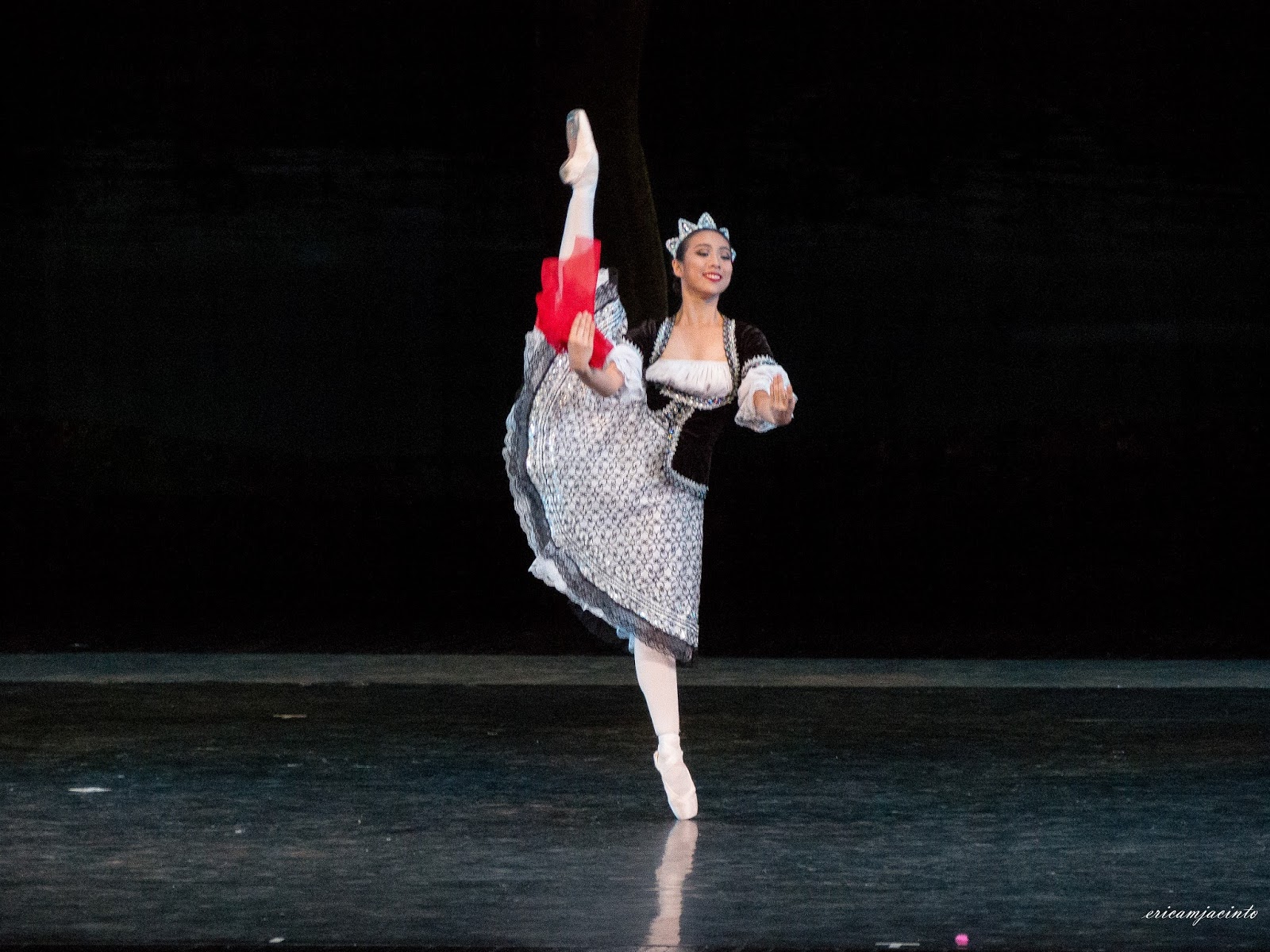
Ballet Philippines opened their season with quite an unremarkable show called "Your Highness" at the Little Theater. It was hardly a production that would mark the entrance of National Artist for Dance Ms. Alice Reyes as the new artistic director of the Company. "A Gala Celebration" which quickly followed was what fully reflected the changing of the guard. Last August 18, 2017, devoid of any frills Ms. Alice Reyes was officially introduced to the audience as the new leadership. A spotlight hovered over the filled up seats and she stood up in the middle of the crowd nonchalantly. With a gentle smile and glassy eyes she went on to address the crowd with a speech that was certainly unexpected. As a founder of the Company I somehow expected her words to be along the lines of tribute to the glory days, direction for the future or this is Ballet Philippines now. After all it is with much anticipation that people waited for her hands to once again touch the company she built. In contrast, she went another way. She chose to make her first public move a step towards gratitude. Without further adieu she individually introduced the people sitting in her row. She acknowledged the work of all other artistic directors who have contributed to the survival of Ballet Philippines. She highlighted that the show that we were about to see was a product of continuity and resilience. Her graciousness was heart warming and endearing. It was the that perfect touch that set the mood of excitement not only for the show but for Ballet Philippines' 48th Season labeled perfectly as QUINTESSENCE.
Neo Classical Gems
The mixed bill showed a wide range of genres from classical ballet, neo classical and modern pieces. The curtains rose to Ms. Reyes' "Bungkos Suite", a delightfully light pursuit to give life to Filipino folk music. Just as it has in the past, the quick and easy ballet done on barefoot played with the usual temperament of the Filipino, naughty and playful.There's peculiar charm brought about the familiarity to the songs. This was one of they lighter pieces of the evening.


Former Artistic Director Bam Damian's " Minamahal, Sinasamba" is also a tribute to original Filipino music. In contrast it played more on athleticism instead of dainty gracefulness. It dealt with different vignettes of love. The piece is largely based on a vocabulary of highly technical partnering. Unexpected exciting lifts, turns and quick solos showed off the inspiring bravery of the young bloods performing the piece. The girls took on the tours and the men caught them in mid air. Tour je tes that end in fish dives, classical finger turns that go from pointe to fondue (bent knee on pointe) were good twists to the conventions of ballet. Gasps from the audience could be heard in regular intervals in appreciation for the the dramatics that occurred on stage.
 |
| PHOTO BY JUSTIN BELLA ALONTE |
Norman Walker's "Summer's End" is one of the classics I have not seen before. Without any tinge of expectation I loved the serenity of the piece. Chopin's music was translated into an unpretentious romance. Real life lovers and principal dancers JM Cordero and Rita Winder impressed me with their flawless partnering. The choreography itself is beautiful but there is a noticeable tranquility as they executed partnered extensions. Their sequences seemed to always end up with a luxurious embrace and the fluidity was soothing to the eyes. More than their solid technique it was their openness to tell a story that was a refreshing. Both dancers who were set to leave right after the performances to their new career destination seemed committed to making their last performance something to be remembered. The end of a romance , the end of a journey was anything but bittersweet.

The Classics
Ballet Philippines made sure they included the classics. Victor Maguad and Jemima Reyes starred in the highly technical Grand Pas Classique. Maguad displayed his usual flexibility and Reyes gave her all to her difficult fouettes and turn combinations. Everything was good but this ballet to me is very static with no highs and lows. My appreciation is limited to how good the dancers are.


Raymonda was more entertaining. Guest Principal Candice Adea led the pack with her movement imbued with rich elan. Every bit the performer, she marked her steps soulfully. Despite her dreary mustard costume she still came out as the bejeweled star of Raymonda. There is much maturity in how she articulates her body and her emotions. Guest Artist Marcelino Libao who partnered her enjoyed his moments on stage .His commitment to style makes him unique.


Modern Greats
Krisbelle Mamangun gave life to Agnes Locsin's epic "Salome" This piece that has gained international recognition in the past still comes out strong after all these years. Deeply rooted to emotion a very mature dancer mesmerized me with her impeccable strength and control. Memorable is her slow as death hinge that leads to the floor.I loved how she rose from her split so effortlessly. Her emotion is internal but visible in eyes. Mamangun is still very much a seasoned dancer. This piece and this dancer is always in my must watch list.

Vision of fire is an acquired taste just because its pace may not fit the "So You Think You Can Dance" progression. But my patience was rewarded because it projected a visual so strong that it allowed me to have a few moments of escape. The movements were quite simple and the dancers had to hold poses for long periods of time while being lighted with rustic colors. They eventually gather together and create movements that resemble flickers of fire. Bodies jump like sparks until the whole stage is ablaze with engulfing power. The flames go stronger and higher. The repetitive steps, kicks and jumps all of a sudden look like a soothing fireplace rather than a crackling burning fire. The piece was so so engaging that it left me in awe. I was in awe of the stamina of the cast. I was also very surprised to be stirred by such a ballet. It seemed abstract but the light to me was symbolic of hope. I try not to read souvenir programs prior to shows because I don't want to be influenced about the meanings of pieces. I actually didn't see what was written in the program but I stumbled on a telling post about Vision of Fire. Choreographer of the piece Edna Vida declared in a Facebook post that the meaning of her piece has changed over time. It has gone from a vague visual concept to something quite personal and spiritual to her. "My piece is about finding God again! In these times of pronounced evil people are sensing Him in a collective spiritual renewal."I saw this after the show. While what I saw was hope instead of God, I did feel the same rejuvenation. It's a gift when a piece cloths audiences with feelings. I am grateful to have had that experience.

Alin Alin Alin ang Naiba
Included in the program are two pieces that do not belong to the Ballet Philippines repertoire archives. Filipino guest artist Marcelino Libao (Hamburg Ballet) brought to Manila John Neumeiers's "Spring and Fall". I feel lucky that this piece was shared to the audience just because it has a lot of history. The solo is actually in tribute of the famous dancer Nijinsky. This solo has generous amount of sweeping circular motions that portray euphoria. Libao was at his best in this piece as he has evidently acquired and embraced Neumeier's style. His massive range of movement to me looks like unadulterated freedom which is soothing to the eyes.

Equanimity choreographed by Paul Ocampo and Wife Chien Ying is also not part of Ballet Philippines' history. The quirky duet performed by the choreographers themselves that deals with the intricacies of marriage was cute. The pedestrian movement that alternated with organic transfers of weight was interesting. Both dancers being senior artists their story telling showing nuances that added texture.

Lastly there was Kun Yang Lin's dramatic "Moon" . Choreographically speaking, the piece capitalized on stillness. A combination of oriental flavor and western contemporary vocabulary, Moon delivered an enigmatic dancer. Victor Maguad sustained shapes gliding through the floor with promenades. In certain points he also fluidly created shapes with this ballet using his white skirt. Thoroughly enjoyable because of uniqueness, Moon was a huge success.

Cohesiveness
"A Gala Celebration" shows a lot of merit. The restaging of all the pieces were on point. While the sets were deliberately minimal, light compensated and beautifully framed the movement. There is much to celebrate. It was a good display of how rich the company is. My only issue was that of cohesiveness. At first the show was packaged to be a tribute to dancer diaspora. Then it was a tribute to repertoire. However, there were pieces that were not created specifically for Ballet Philippines nor were they part of their history. Dancers who were leaving and or celebrated surprisingly had minimal parts. There were featured dancers who were also not a significant part of the Ballet Philippines journey. Collectively it did not leave a definite message about what that show was really about. It did not quite deliver what it promised. Much like a sentence without a period, it leaves you questioning the intentions. To me, it was simply a regular mixed bill performance. Nonetheless, I did enjoy its entertainment value.Diversity and strength are an artist's best friends and they were right there on stage guiding the company's every move. This brings forward the reality of their season mantra quintessence. I can see the effort of the dancers to please no less than the National Artist for Dance and the founder of their Company Ms. Alice Reyes. Bravo Ballet Philippines. I can't wait to see the direction they will take as they step nearer to the golden era.
A few of my favorite moments from the show