Showing posts with label ALICE REYES DANCE PHILIPPINES. Show all posts

Monday, May 6, 2024

International Dance Day Fest 2024, Unity in Movement


Ayala Land, Make it Makati, Circuit Makati, and the Samsung Performing Arts Theater made history by launching the first-ever four-day International Dance Day Festival in the Philippines. What makes this festival unique is its equal emphasis on various dance genres. The festival commenced on April 25, 2024, with a vibrant performance of the folk dance community, followed by an electrifying hip-hop night. On the third day, ballet enthusiasts gathered for a priceless ballet gala. The festival came to a close on April 28, 2024, with a night dedicated to contemporary dance. The event utilized a total of one thousand one hundred seventy-eight artists across the four-day event. With such a large number, it is safe to say that it was a true representation of the dance community. It is a rarity that would be a hard act to follow.


This event attracted diverse audiences who were eager to witness the talent of the dance community. With approximately two thousand five hundred attendees, the festival clearly demonstrated the demand for such programs. There is a thirst to see our talent in the spotlight. Chris Mohnani, the managing director of the host theater, accurately stated, "This pioneering event reaffirms our belief in the transformative power of the arts to unite, inspire, and uplift." The enthusiastic response from the audience indicated that dance had captured people's attention. It was unity in motion on stage and backstage.

It was thrilling to experience a sudden resurgence of artistic energy at the ballet gala last April 27, 2024. The event showcased a well-curated selection of performances that highlighted the talent and competence of the ballet community. The curtains opened, revealing the full glory of the theater with Philippine Ballet Theater's iconic piece, "Vinta", choreographed by Gener Caringal. the music filled the air and the sounds of gusty wind dominated, the audience gasped at the beautiful imagery displayed by the company. PBT looked much like the PBT of the old days, with a fleet of elegantly beautiful, statuesque, and delicate dancers exuding undeniable charm. Vinta was an awe-inspiring visual experience.


Alice Reyes Dance Philippines also made a strong statement with their performance of After Whom, choreographed by Bam Damian. In contrast to PBT's calm, they brought forth a storm of energy that captivated the audience. This piece has always been known for its technical difficulty. It was truly impressive to see the new generation of ARDP dancers rise to the occasion. They left
a lasting impression of this performance.


Ballet Philippines then took the stage with "Diyosa," a fusion of technology and dance. Choreographed by Mikhail Martynyuk, the dancers flexed their competence against strong light projections. The piece mainly focused on utilizing the body to create picturesque formations and aesthetics. Jemima Reyes who was at the forefront of the vignettes displayed meticulous articulation of the body. 


Ballet Manila closed the show with their vintage offering, Dancing to Verdi, choreographed by the late Tony Fabella. This piece was just so incredibly fast and difficult that it quickly reminded me that Fabella was ahead of his time. The footwork combination alone was not for the faint of heart. Ballet Manila's dancers remained calm and composed as they navigated the difficulty of the piece, all while wearing a classic smile on their faces. Shaira Comeros stood out with her impeccable technique and quiet elegance. The audience showed their appreciation for the many difficult steps she conquered.


Returning to the local stage was Pinoy pride, Garry Corpuz. Thanks to Hong Kong Ballet and the generosity of Elaine Forsgate Marden, our local audience had the opportunity to see Corpuz in his finest form. He performed in two numbers, partnering Quingxin Wang in Amor Volte Undique, choreographed by Septime Weber, and the Black Swan Grand Pas De Deux. Both numbers received thunderous applause. In Swan Lake, Wang showcased her extended balance in arabesque, spanning more than five seconds. She did not disappoint with her arabesque to pirouette series, occasionally even landing triples. But more than the tricks, she was delightfully sassy and charismatic. Corpuz has always displayed clean technique, but after years with Hong Kong Ballet, he now exudes the confidence of an International star. Their second number by Septime Wember was a visual treat, with lovely partnering lifts, extensions, and turns. The piece was sophisticated and simply satisfying. The Principal pair was surely the crowd favorite of the evening.


The professionals brought their A-game. But it wasn't just them who delivered. In addition to their performances, the program also featured the future of ballet with performances by Steps Dance Studio, Hope Academy of Dance, Halili Cruz School of Ballet and the Association of Ballet Academies of the Philippines. These esteemed institutions surprised the audience by presenting pieces with serious themes. The young generation demonstrated their unwavering dedication to dance through their passionate performances.


The ballet gala undoubtedly achieved tremendous success. The participating groups understood their role perfectly, ensuring that the audience experienced a diverse range of inspiring performances.  Kudos to Ayala Land and all its collaborators for drawing the attention to our artists. Investing in artists is not common but this event shows that it can be a powerful force for good. In line with the original intention of International Dance Day, the festival beautifully paid homage to dance by uniting communities through movement. It reiterated that Filipinos are special in their own right, and deserving of the world stage. 

In the scorching heat of the Philippines, the International Dance Day Festival was like a much-needed breeze. It felt like a nightcap that soothed the senses and just allowed the audience to focus on something beautiful for once. In a world where everything is a competition, a moment of friendship and unity can be just what we need to be inspired to do better. 

Thursday, November 2, 2023

REVIEW: ‘Carmen and Other Spirits’ is a Loud Call to Action ( Archive Republished)


Republished from Theaterfansmanila Nov 1, 2023 


This four-part mixed bill performance offered by Alice Reyes Dance Company Philippines is a loud call to action from different generations. The performance was a curated show featuring three choreographers of different ages highlighting what was (or still is) relevant to them.  

The curtains opened to Alden Lugnasin’s “Swimming the Ilog Pasig” which was a social commentary on how indifferent we have become to the glorious Pasig River and the environment that it adequately represents.  It was then followed by “Two” choreographed by Ronelson Yadao which was a life commentary about the duality of people. Next was Lester Reguindin’s “Now”, an environmental commentary about climate change. Lastly, Alice Reyes’ “Carmen” is still a social commentary about the strength of the woman. 

It may not have been done on purpose, but for this author, it looks like a snapshot of what was important through the decades: eighties, nineties and, now. It’s intellectually filling to see pieces with a lot of depth and history. These kinds of pieces will be seen by the next generations with a different perspective but they will have an idea of how things were during the lifetime of these choreographers in a beautiful way. 


Swimming the Ilog Pasig

Swimming the Ilog Pasig by Alden Lugnasin; Photo Credit: Erica Feliz Marquez-Jacinto


Alden Lugnasin’s piece “Swimming the Ilog Pasig” premiered in 1989. At that time, highly graphic images of the Ilog Pasig, filled with trash, were widely discussed. When Ballet Philippines II performed it, the piece had a strong impact.


Years after, this restaging performed by ARDP still resonates with the audience even if the Ilog Pasig is no longer front-page news. The piece starts with the innovative use of bleachers that allow the audience to zoom in on the beautiful movement Lugnasin sets on the dancers. Using the aesthetic of synchronized swimming, he exhausted all possible visuals capturing a swim.  

Lugnasin’s intricate silhouettes demanded a high level of technique, agility, and body strength from the dancers. The dancers delivered with precision and stoic commitment. In the beginning and towards the end of this piece they scream the word “Hoy!” as if to call out what the people have done. As they scream, they look at absolutely nothing, but this simple word already did its job and triggers the mind to imagine what damage they are referring to.  The word encapsulates the disgust for the status quo. I felt it. 


Two


Two by Ronelson Yadao; Photo Credit: Erica Feliz Marquez-Jacinto


“Two” choreographed by Ronelson Yadao is a piece about how people need people. It’s a duet that really is just about energy bouncing off from one to another. Monica Gana and Tim Cabrera showed off their seamless footwork, drops on pointes that transition to the next set of difficult steps. 


In this piece, the two dancers hardly let go of each other with each step stitched to the next. “Two” is a showcase piece with a simple message, one cannot live alone. It may not have represented that message strongly, but it did showcase beautiful dancing. 


Now

Now by Lester Reguindin; Photo Credit: Erica Feliz Marquez-Jacinto


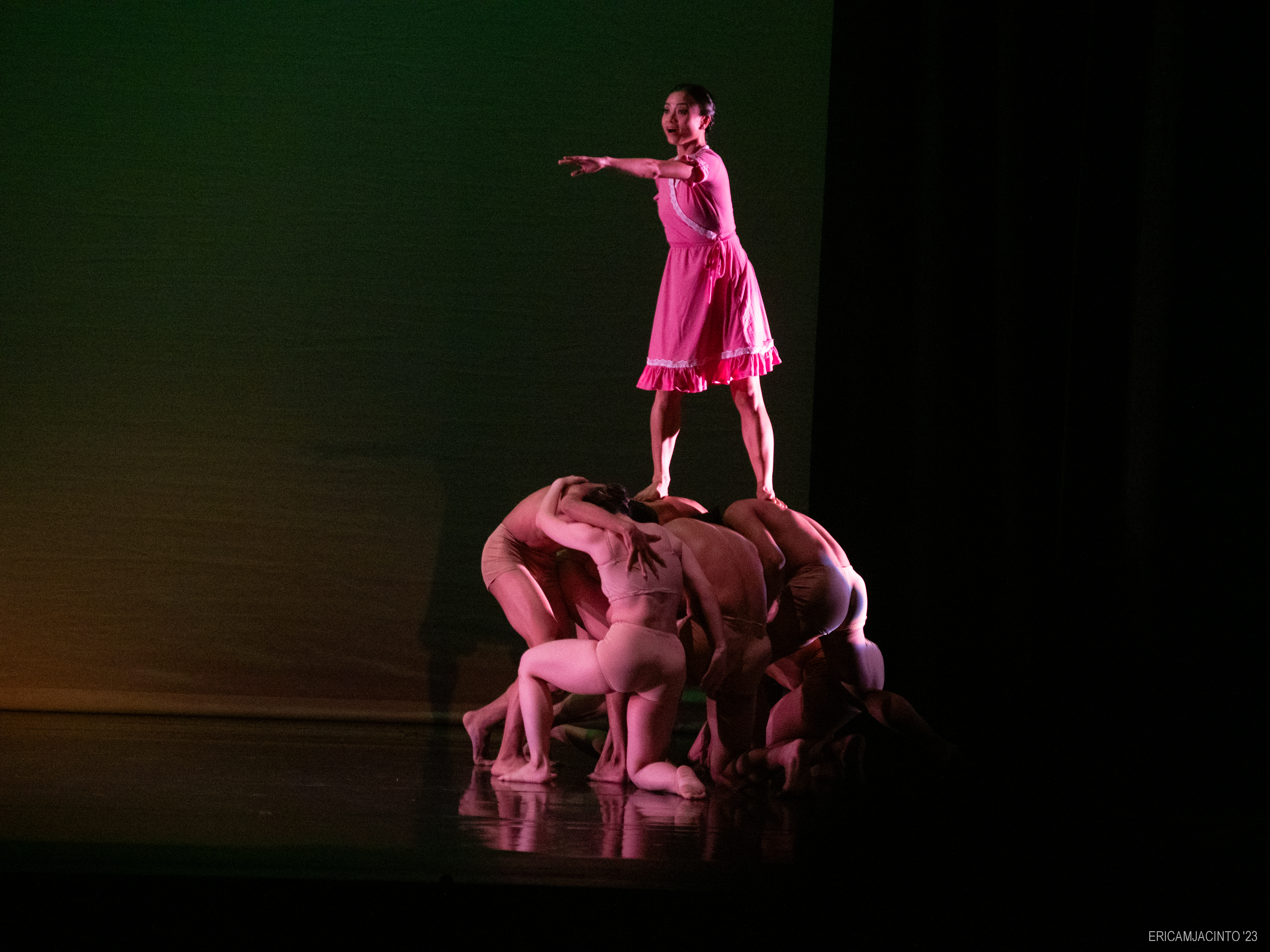
“NOW” by Lester Reguindin was just so poetic. It is devoid of any frills and delivers a story so pure and so truthful that it will make you feel part of the story. Inspired by Greta Thunberg’s speech on climate change, his piece started with a young girl played by Janine Arisola completely enamored by her perfect world. The dancers were her nature organically moving with her.  


Playfully dancing with nature,  Arisola showed the innocence of a child appreciating the world’s beautiful gifts. Her momentum is tragically broken by the realization that her world and her future are under attack. Men in suits came in with chairs and her bodies of nature started to wither. 


As the music transitions to excerpts of Greta Thunbergs’ speech, the child in Arisola is distraught. In Arisola’s solo, she articulates the words of the speech as if it were her own. The words were expressed so well in movement that the audio almost seemed like she was speaking it. With her small frame, she gave life to every movement given by Reguindin. 


She projected her movements with boldness and with so much clarity and passion that she triggered an overflow of emotion much like how Greta’s impact was when she spoke out to the world. There is a picturesque moment in this piece where the men in suits dance as if they were belittling her. They appear larger than life in massive shadows that would scare any child.  


But the movement and the words came together. Scared she was not. Verbatim, “How dare you? We will never forgive you. We will be watching you. I deserve better.” And as the men stopped to listen in their chairs and slowly danced in unison with Arisola’s call to action. His art much like Greta Thunberg’s voice cannot be silenced. “NOW” actually stands for NEEDS OF THE WORLD that need attention now. In this staging, Regindin demands your attention.  


Carmen


Carmen by Alice Reyes; Photo Credit: Erica Feliz Marquez-Jacinto


Last but not the least is Alice Reyes’ “Carmen”, a fitting ending to this mixed bill. I can only imagine that when “Carmen” premiered in the eighties, it raised eyebrows with its anti-hero theme. Nobody is an angel in this story. Contrary to what is expected, this version is about Don Juan’s narrative, not Carmen’s. It was a tale about a man losing every shred of dignity he had because he loved a woman like Carmen. 


In this staging, Carmen was a picture of confidence and freedom. She believed that love was fleeting and lingered indefinitely. She lived for the moment. She knew what she wanted and unapologetically demanded for everything she wanted. In full contrast, Don Juan was weak, compromising, insecure, and temperamental.  


Macel Dofitas and Richardson Yadao who took on the lead roles, fully committed to these characters. With their authentic chemistry, nothing was manufactured in their portrayal. Dofitas was like fine wine, full-bodied and rich. With each scene, she became sweeter with her charisma and her movements commanding the stage. Yadao on the other hand was sensitive in his portrayal and put all the attention to his narrative. 


While their onstage love story ends tragically in death, their love scenes were swoon-worthy. Reyes cleverly crafted a beautiful pas de deux for Don Juan and Carmen. The choreography was made with nuances that made both an impact on aesthetics and storytelling. 


Dofitas with the power of a soft touch would melt Yadao and make him quiver and succumb to a back bend. She would swirl around her hips and he would lift her in the air with her lithe body in the musical climax and she would descend sensually with her body pressed on his.  


Particularly memorable would be the partnering combinations that would be executed while the two were locked in a kiss. Technically very difficult to perfect but these two leads did them organically. Carmen in these scenes commanded the relationship and Don Juan overcome with emotions embraced the excitement. 


While there was love at the center of their pas de deux, it never was the same amount from both parties. The same attention to detail can be seen throughout the ballet. Reyes seemed to have laced every scene with poetic expressions. This ballet shows depth, a wealth of movement vocabulary, and masterful skill of storytelling. What better proof of this than the touching last scene of Don Juan’s death. 


After sharing his story, he walked towards the end of his life. Yadao ascended the stairs shaky with emotion. Embraced by darkness, he looks up at the light and ever so gently hinges while the light dims and covers the stage in total darkness. The sets themselves were also a sight to behold. 


Salvador Bernal’s architectural design approach really framed the scenes well. While I loved this ballet over all, there were a few things that bothered me. I love the incorporation of flamenco music by Antonio Olsera and Paco de Lucia  in this ballet. However, some of the musical transitions were a bit rough. Mixing music is a challenge because the temperament and texture are not aligned. Also, because the music is recognizably flamenco, the dancing needed a bit more attention to detail for refinement. Flamenco requires specific wrist and finger movements to make it convincing.


Dofitas was generally excellent in her acting but I also would have liked to have different looks of love for each of the men she was involved with. I also would have loved to see this entire ballet on pointe similar to other adaptations. These little details did not significantly take away from performance but they did linger in my thoughts as I was watching the ballet. 


Overall, however, in “Carmen”, the message was clear: who runs the world nowadays? Girls. 


Tickets: Orchestra Center │ 2,500 Orchestra Side │ 2,000 Loge │ 1,000 Balcony 1 │ 500 Balcony 2 │ 350 Show Dates; October 20, 2023 | 7:30 PM October 21, 2023 | 4:00 PM Venue: Samsung Performing Arts Theatre Running Time: 1 hour 30 minutes (including a 10 minute intermission)

Credits: 

Choreographers ( Swimming the Ilog Pasig) Alden Lugnasin, (TWO)  Ronelson Yadao (Now)  Lester Regindin (Carmen) By Alice Reyes 

Artistic Director : Ronelson Yadao 


Cast: 


Swimming the Ilog Pasig 

John Ababon, Dan Dayo Erl Sorilla, Renzen Arboleda, Sarah Alejandro, Katrene San Miguel, Karla Santos, Michaella Carreon, Krislynn Buri


Two

Tim Cabrera, Monica Gana 


Now 

Soloist: Janine Arisola

Ensemble:John Ababon, Dan Dayo Erl Sorilla, Renzen Arboleda, Sarah Alejandro, Katrene San Miguel, Karla Santos, Michaella Carreon, Krislynn Buri,Monica Gana Gianna Hervas, Cehska Vasallo, James Galarpe, Fasutina Francia Alejandro, Cris Jay Malipot, Erica Patoc , Kamille Bautista 

Carmen 


Lead Roles : 

Carmen Ma. Celina Dofitas

Don Jose: Richardson Yadao

Prosper Merimee : Erl Sorilla

Escamillo : Renzen Arboleda 

Zuniga: Ejay Arisola 

Ensemble:John Ababon, Dan Dayo Erl Sorilla, Renzen Arboleda, Sarah Alejandro, Katrene San Miguel, Karla Santos, Michaella Carreon, Krislynn Buri,Monica Gana Gianna Hervas, Cehska Vasallo, James Galarpe, Fasutina Francia Alejandro, Cris Jay Malipot, Erica Patoc , Kamille Bautista , Christian Valerio, Justin Joseph Fraginal, Ricmar Bayonete, Lester Reguindin


Monday, July 24, 2023

Philippine Dance History ; Freedom to Choose the Filipino


After the blistering effect of the pandemic, the 2023 dance season of the major dance companies seemed to carry more weight. All four ballet companies Philippine Ballet Theatre, Ballet Philippines, Ballet Manila, and Alice Reyes Dance Philippines fought tooth and nail to fight for their companies' art. They had to fight to keep funding. They had to fight to keep their dancers. They had to fight to keep their audience. With CCP closing its doors and casting a shadow over its 2023 season, you would think the return to stability would be choosing a safe repertoire that can surely make money. Thankfully not everyone went this route. Despite the uncertainty, it looks like there is a thirst to regain a voice, a platform to use to advocate for Filipino themes. 

Alice Reyes Dance Philippines opened its season with an epic restaging of Encantada choreographed by no less than National Artist for Dance Agnes Reyes. While this masterpiece is well-loved by the dance community it attracts a specific niche market. In a way, it alienates the ballet kid market because of its dark theme and specialized genre. Their risk paid off with masses of people shouting out praises for a meticulously prepared high art project presented to the people. Your guess is as good as mine if you ask me if it made money. To me, at this point, it shouldn't matter. It put a barely one-year-old company on the map. It showed a passionate display of commitment to preserving Filipino masterpieces and giving dignity to the work of Filipino collaborators. It was not just the ballet that was gloriously lauded by many, it was also the pulsating music of Joey Ayala and the bold  libretto by Al Santos.


Philippine Ballet Theatre will open Ibalon the ballet this coming July 28 and 29, 2023 at the Samsung Theatre. It will tell the perspective of one of the stories of Bicol that has been passed on for generations and generations by mouth. They too will take a risk and present a product of a full collaboration of Filipino Artists. The ballet is choreographed by the company's artistic director Ronilo Jaynario, with music by Paulo Zarate with special effects by Fortunato Co and Enrico Navarro. The ballet has not even premiered yet it has gained so much attention from the music, theater, and dance community. The support for this ballet shows that there is a thirst for something Filipino-made. Perhaps PBT has more to lose if this ballet does not earn well. Looking at ticket availability, Ibalon already has made a tiny win for PBT. Wouldn't that be great if this ballet is received with intensity?! It would a be beautiful statement,  "Choosing Filipino is rewarding". 


Ballet Manila will close its 25th season with Gerardo Francisco's Ibong Adarna this August 19 and 20, 2023 at the newly renovated Aliw Theatre. As known to all this ballet is also a product of an all-Filipino team. The music was composed by Diwa De Leon, the script was written by Angela Blardony Ureta, and the costumes and sets were by Make It Happen Workshop. While global exposure and collaborations are fruitful, it's always nice to see the products of an all-Filipino team. It's a pity that school is on break because this would have been a perfect education tool for the youth. It certainly breaks down the story in a memorable way. I have seen this ballet many times and it has evolved each time. I'm pretty sure the new serving will be a crisp showing of Filipino literature. 

As the controversial new Department of Tourism campaign says "Love the Philippines" in a deeper manner. These companies have already made a statement by choosing to make the stage their platform to show the glory of our Filipino artists. Maybe it's time the locals made time to follow their lead and support Filipino dance collaborations. It's a guaranteed win. Our presence in the theatre helps immortalize the work that was done, it helps our dance companies thrive not survive and it helps spread Filipino stories. It just feels like the right decision to choose Filipino as we regain our freedom to see more art. Let's celebrate the greatest blessing coming out of the pandemic. Let's use our newfound ( and much-appreciated) freedom to be Filipino. See you at the theatre. 


Check out these links to find out more about their shows. 

1. ARDancePH

RAMA, HARI (Upcoming show) 

September 15-16, 2023 | Metropolitan Theater September 22-23, 2023 | Samsung Performing Arts Theater

2. Philippine Ballet Theatre

July 28-29, 2023  | Samsung Performing Arts Theater

3. Ballet Manila Official 

August 19-20 2023 | Aliw Theater, Pasay City


Wednesday, May 10, 2023

REVIEW: Third time’s a charm with ‘Encantada’


Republished article ... Original release can be seen in this link THEATERFANSMANILA


Alice Reyes Dance Philippines opened its season with National Artist Agnes Locsin’s  neo-ethnic ballet “Encantada”.  Starting strong, their first run at the Samsung theater elicited long-running curtain calls, standing ovations, and heartfelt declarations of acceptance. But nobody was prepared for the display of love on opening night at the Metropolitan Theater last April 21, 2023.  The phrase “and the crowd went wild” is usually reserved for sports arenas but  this old ballet from the 1990s  made it happen in the iconic theater. 


Encantada was the brainchild of three radical artists. Al Santos wrote the libretto, Joey Ayala the music and finally, it was directed and choreographed by Agnes Locsin. At the time of its premiere everything that they did was unorthodox. The theme was about taboos, the dance genre was contemporary and the music was tribal ( which was not your go-to music for ballets). The product was fresh and the audience embraced it.  In 2011, it was restaged by Ballet Philippines and it won numerous awards. But a lot has happened since then. The production value of shows has been inventive, contemporary dance is now at the forefront and the music industry has opened up. I wondered if the ballet could remain as potent as it was when it was created. Opening Night proved that this ballet was indeed a timeless classic. 


Purposeful Libretto


The curtains opened revealing Salvador Bernal’s majestic multilevel mountain glistening under the light of John Batalla. The moment of stillness would prepare the audience for a powerhouse performance of music, dance, and theatrics. With her feet grounded and connected to Bernal's mountain, Encantada played by Georgette Sanchez- Vargas descended from the top of the mountains and roused up the kababaihan. It was a soothing warm-up for the telling of a story laced with multiple social critiques on religious hypocrisy, the power divide in society, the violence against women, the oppressed, and the environment. 


The story has two different sectors that live by faith. The pagans of the mountains were the Kababihans who relied on their mystical Encantada and the devout Christians who lived in civilization. Through the narrative of the Estranghero who was a devout Christian, the abuse of  people and environment by the powerful Frailes would be told. In each major scene, Locsin was able to share a strong message.  For instance, in the story, the conflict intensified when the Christian icon of the Virgin Mary was turned over to the pagans who undressed it and worshiped them as their god.   This depicts that both sectors believed in the same higher power packaged differently. In the end, it is how you live your life in faith that is the true battle. 


In the story, the estranghero was saved by the Kababaihans from pain inflicted by his own sector. While he remained a devout  Christian he recognized the kindness of pagans and even lived with them in their sanctuary. The message is loud and clear different religions can coexist. 


The role of the estranghero was also quite powerful as it showed that the true devout could easily be persecuted by the powerful. The estranghero was pursued by the Frailes and the Guardia Sibil to his death. Consistent with our history as a nation, many of our heroes who have stood up for what they believed was right suffered. They were always the catalyst of change, the heroes that would be remembered.  


In the climactic battle between the Guardia Sibil and the Kababaihans,  they destroyed the environment and the spirit of the people. This is a direct call out not to bite the hand that feeds you.   There are many more poetic declarations in the scenes that the audience could pick up. Collectively the nuances have made the ballet a powerful social commentary. 


Locsin Choreography 


The pulsating music of Joey Ayala and Bagong Lumad evoked a vibe. It was ingenious to have the musicians hidden in the mountain. It seemed to breathe life into the mountain. In too many ballets, the singers take away the attention from the dancers but in this performance, the voices reverberated from the stage in the most glorious way. I am certain the dancers being so close to the live music could feed off the energy of the singers. Locsin’s rhythmic steps like stomping furiously to the beat of the music intensified the scenes bringing on  the 


Playing off the elemental sound Locsin’s choreography was a delicate display of nature. Memorable is the scene where the kababaihan heals the estranghero through the help of the Babaylan and the Encantada. Encantada lifts her arms to the sky and in a dramatic gesture pours healing into the hands of the Babaylan which the Babaylan then transfers to the Kababaihan. In this scene, the women act as a conveyor belt moving the body of the estranghero forward with their bodies. It looked like a  magical stream of water being poured out from the sky to his ailing body.


Similarly, in the scene of the great flood, bodies were rolling on the floor like objects swiftly being carried away by the current. There were scenes where the element of wind was the core aesthetic. The ensemble would run furiously in a circle creating the image of a human hurricane with their hair swept away from their faces,  the central energy mounting on stage. In the grand finale, the kababaihan toss their hair up and down like being one with the wind. Swaying hips, bendy torsos and a tempo that mimics gusts of wind created beautiful images.  


The beauty of Locsin’s choreography lies in how the movements themselves easily build up the characters of the story. For instance, Encatada could have been portrayed as the stereotype of mother earth,  colorful and vivacious. Instead,   Locsin’s Ecantada had the soul of a mother with hands that lifted in prayer, hands that could heal, hands that could nurture, and hands that could share joy. Her hand articulations were enough to convey emotions.  Her grounded movements established that she was part of the earth. Her feet were deeply grounded with most of the steps on fondu (on leg bent) but her upper body movements were weightless somewhat explaining that she is divinely connected to the heavens but rooted in service to the mountain and its people.  The Kababaihan ensemble had a lot of linked arms and intertwined bodies which emphasized their sense of community and harmony as opposed to the jagged and non-unified choreography of the violent angular movements of the Guardia Sibil.  


It could easily be my imagination but having seen this ballet multiple times, I started to notice picturesque scenes with a likeness to historical events. For instance, in the scene where the Estrangero was beaten up,  the two guards held both his arms and lifted him off the ground. His feet were intertwined and it looked like  Jesus on the cross. His role was a devout being persecuted and so it made sense. Alternatively, It could also be like  Rizal’s death scene where he falls on the floor because he dared revolt. In the scene where the Guardia Sibil were raping the women, they go to a circular formation and scream out their pain. It looked like there was a reference to Dantes's Inferno, where the mangled bodies scream in the sinner's haven. 


There were also so many references to Filipino heritage embedded in every major scene like the  Marinduque’s Moriones Festival, Manobo healing rituals, and ati atihan. It showcased  Filipino culture albeit reinvented in an alternate imaginary Locsin universe. 


Passionate Dancers


While I believe the material is the real reason behind the show’s success, the performers really brought their a-game. Neo-ethnic style is something hard to acclimatize with but the dancers seemed intent on giving justice to the choreography. Their passionate acting brought the story to a different level. Considering the technical demands of the ballet the cast’s endurance was amazing.


Georgette Sanchez-Vargas as the Encantada owned the stage displaying artistic maturity. Being a Locsin-trained dancer she was able to articulate Locsin’s vocabulary with ease. She traversed through the mountain levels with confidence. Despite being so high up in the mountain, her emotional scenes were strong enough to puncture the audience and elicit tears.  Carissa Adea who performed the role of Babylan showed a different temperament than the pioneer cast but was equally effective. She emphasized empathy and community in her storytelling. Ronelson Yadao who played the estranghero and Lester  Lester Reguindin who played the Fraile were dynamic in both their acting and their dancing contributing greatly to the drama. 


Third Time’s a Charm

This third staging of Encantada was successful for a reason. It gave full attention and respect to the material, the creators’ intention, and most importantly the artists.


Restagers Alden Lugnasin, Annette Cruz-Mariano, and Judelle de Guzman-Sicam drew from their experiences. The nuances that could easily be forgotten and imagery that could easily be non-recognizable were clear as day in this staging.


With Agnes Locsin herself at the helm of this production, she was able to school audiences that theater is not about glorifying one person’s art, it is about making sure everyone’s art comes alive. It takes a village to show something worthwhile. When the National Artist for Dance was asked how she felt about the outcome she said that everything fell into place and that she was happy about this staging. Indeed there is much to be happy about.


This now iconic ballet and the Alice Reyes Dance Philippines Company have just re-established the gold standard for creating a Filipino ballet.


Tickets: Php Free ( Registration Required)
Show Dates: April 21 - April 22, 2023
Venue: Metropolitan Theater 
Running Time: approx. 1 hour and 45 mins
Credits: Agnes Locsin  (Director), Agnes Locsin (Choreographer), Ronelson Yadao (ARDP Artistic Director), Joey Ayala (Composer), Al Santos (Librettist ), John Battala (lighting designer), Salvador Bernal  (Set Design, Costume Design), Salvador Bernal  Reproduction Consultant (Eric Cruz) Set Construction Supervisor  (Erlinda Arcega) Restagers (Alden Lugnasin, Annette Cruz- Mariano , Judelle De Guzman-Sicam)
Featured Cast:  Encantada ( Georgette Sanchez-Vargas), Babaylan (Carissa Adea), Estranghero (Ronelson Yadao), Fraile (Lester Reguindin), Joey Ayala, Bagong Lumad
Company: Alice Reyes Dance Company